The universe works in layers, and to understand the biggest and wildest events, like a star blowing up or a nuclear reactor producing power, we have to zoom into the tiniest parts of the reality. This is where particle physics quietly shapes nuclear physics. For years, nuclear science mainly focused on protons and neutrons, the particles that form every nucleus. But modern physics changed everything. To reach actual precision, scientists realized they must look inside those particles. And that’s where the story of quarks and leptons comes alive.
Quarks build the protons and neutrons themselves, while leptons drive many of the decay processes that define nuclear behavior. So now, studying these fundamental particles is not just a theory-driven exercise. It’s a practical key. It helps us design safer nuclear reactors, create more targeted medical treatments, and uncover the universe’s deepest truths. Simply put, whatever happens at the subatomic scale directly shapes the forces, reactions, and stability of the nucleus.
In this exploration-first guide, we will move step by step, from the smallest building blocks to the practical breakthroughs they unlock. And along the way, you will see how these hidden players reshape our models of the nucleus and expand what we can do with nuclear science.
Understanding the Building Blocks — Quarks, Leptons & Forces
Before we can discuss how these particles shape the nucleus, we must meet the particles themselves. These are the fundamental fermions, the matter particles, that can’t be broken down further.
A. What Are Quarks?
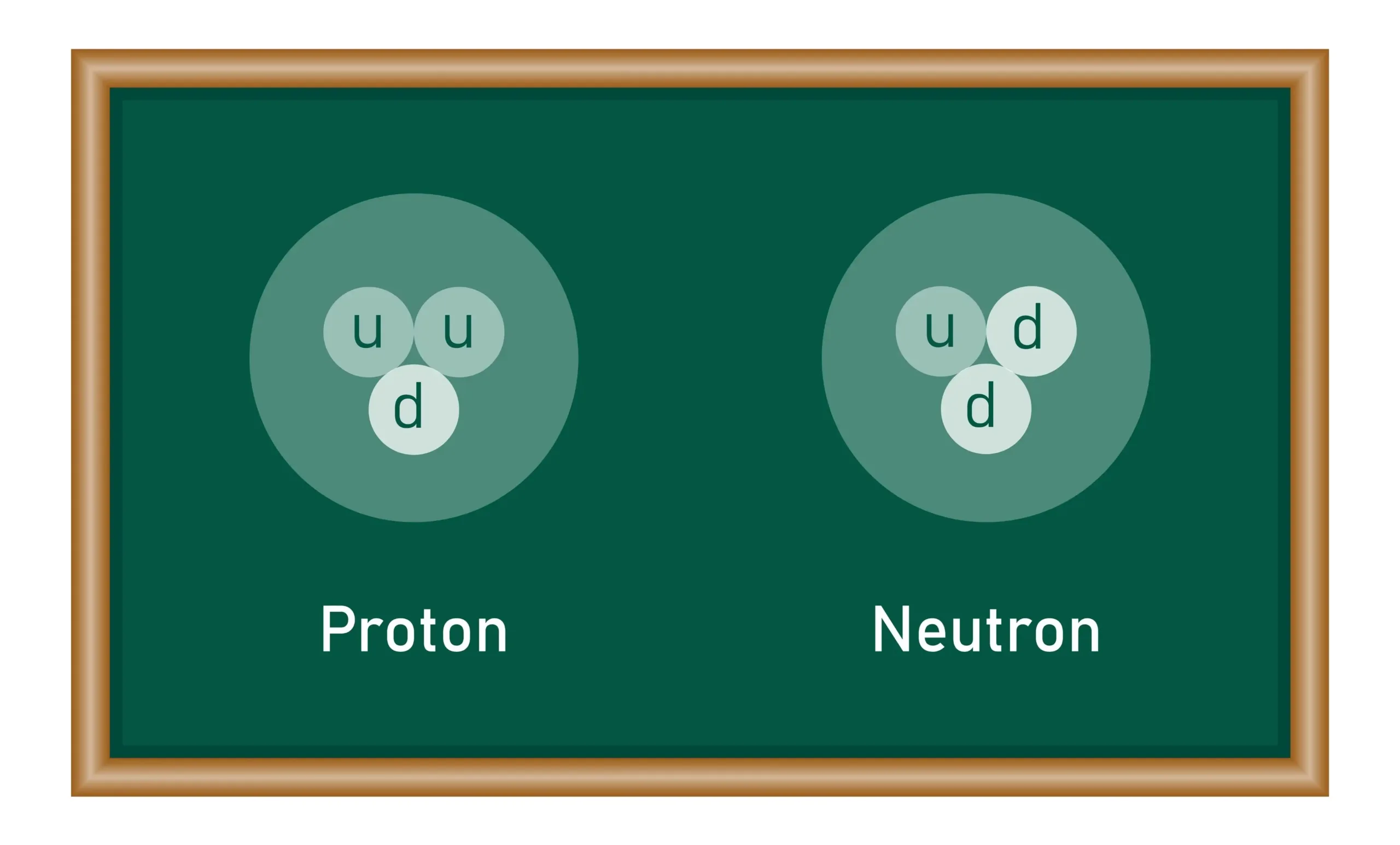
Quarks are the fundamental units that make up nucleons, the protons, and neutrons inside an atomic nucleus. They come in six “flavors”: up, down, charm, strange, top, and bottom. But for normal matter, only two matter:
- Up quark (+⅔ charge)
- Down quark (−⅓ charge)
A proton = uud
A neutron = udd
Quarks can never exist alone thanks to a quantum rule called confinement, which locks them into groups via quantum chromodynamics (QCD), the theory that explains the strong nuclear force. The strong force doesn’t just keep quarks together; its leftover attraction binds entire nuclei. This “glue” is why stars burn, why uranium splits, and why matter is stable at all.
B. What Are Leptons?
Leptons are the other class of fundamental matter particles. They do not experience the strong nuclear force, meaning they are not bound up inside the nucleus. There are six types of leptons, also in three generations:
| Generation | Charged Leptons | Neutral Leptons (Neutrinos) | Charge (in units of e) |
|---|---|---|---|
| 1st | Electron (e-) | Electron Neutrino (nu_e) | -1, 0 |
| 2nd | Muon (mu-) | Muon Neutrino (nu_mu) | -1, 0 |
| 3rd | Tau (tau-) | Tau Neutrino (nu_tau) | -1, 0 |
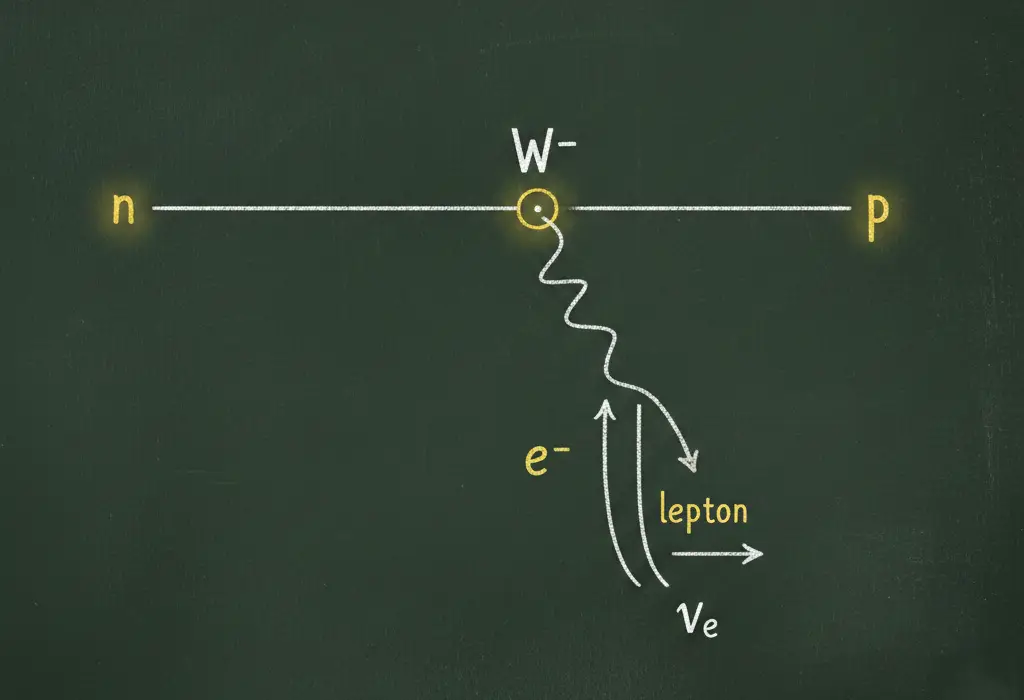
The electron is the most familiar lepton, orbiting the nucleus and mediating chemical reactions. Critically, leptons are deeply involved in weak interactions, which are responsible for beta decay—the process by which a neutron turns into a proton (or vice versa), allowing unstable nuclei to achieve stability. This process involves the emission or absorption of an electron (or positron) and a neutrino. The role of leptons in nuclear processes is thus central to radioactivity.
C. The Four Fundamental Forces
Everything in the universe dances to four fundamental forces:
Strong Nuclear Force: The heavyweight champion, binding quarks into nucleons and holding nuclei together despite electromagnetic repulsion between protons. Operates at femtometer scales (10⁻¹⁵ meters).
Electromagnetic Force: Governs interactions between charged particles. Responsible for atomic structure and chemical bonds, but also tries to rip nuclei apart due to proton repulsion.
Weak Force: The transformer, enabling particles to change identity through processes like beta decay. Critical for stellar fusion and radioactive decay chains.
Gravitational Force: The weakest by far at particle scales but dominant at cosmic distances. Essentially irrelevant for nuclear physics, though it matters for astrophysical contexts like neutron star cores.
At nuclear scales, the strong and weak forces dominate, while electromagnetism provides important corrections. Gravity? It’s taking a nap.
The Standard Model Explained: Understanding Quarks and Leptons in Nuclear Science
The Standard Model is basically particle physics’ greatest hit. It acts as a powerful framework that explains how fundamental particles and forces work together. Think of it like a cosmic version of the periodic table, but designed to map out everything that exists at the smallest scale.
At its core, the Standard Model groups particles into two major categories:
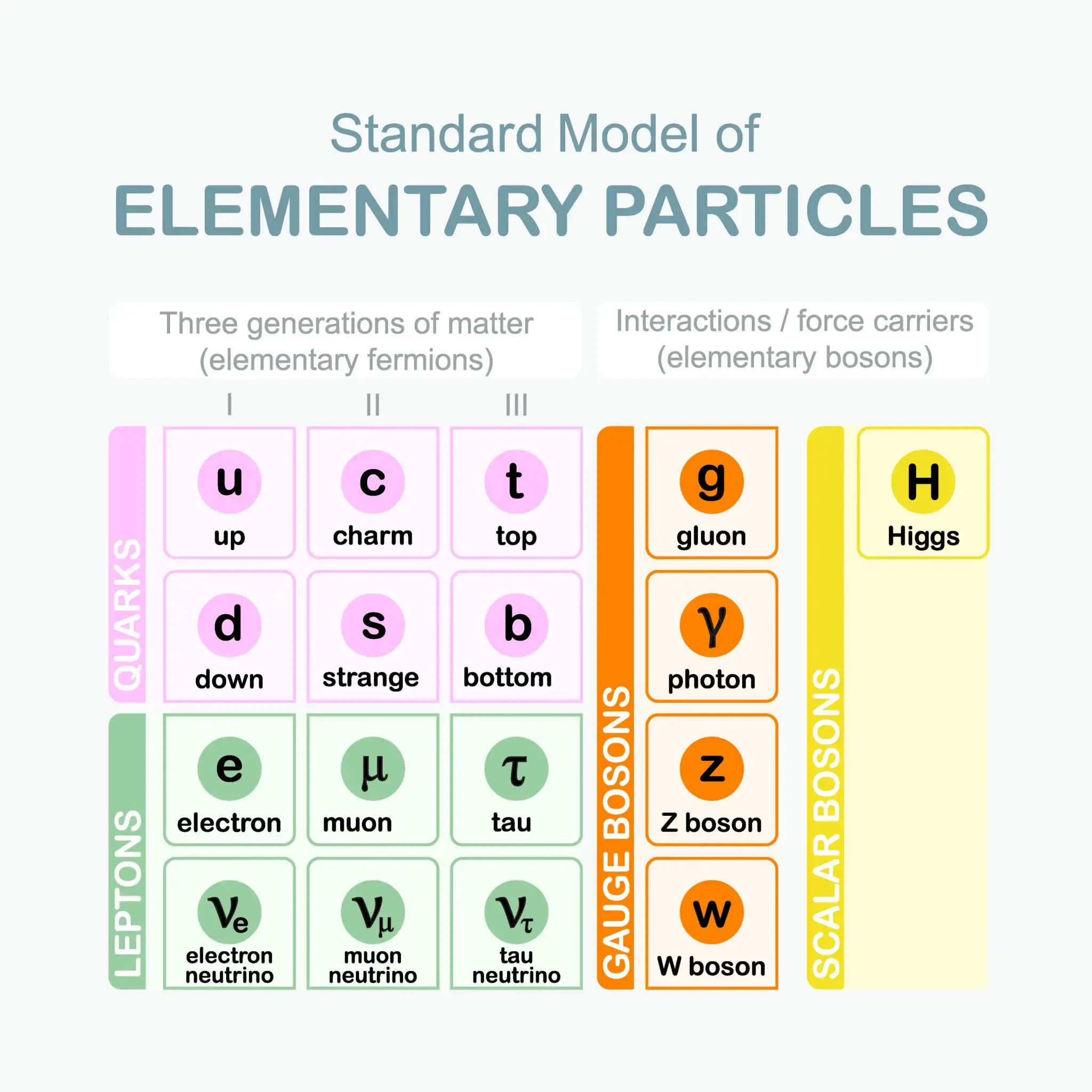
- Fermions (the matter particles): These include quarks and leptons. They follow the Pauli exclusion principle, meaning no two similar fermions can occupy the same quantum state. This is why atoms have structure and why you don’t fall through your chair.
- Bosons (the force carriers): These mediate the fundamental forces. Gluons carry the strong force between quarks, W and Z bosons handle weak interactions, photons convey electromagnetic force, and the Higgs boson gives particles mass.
Here’s where things get really exciting for nuclear science: the particles in the Standard Model don’t act alone. Instead, they shape a whole interconnected system where quark-level behavior directly affects how nucleons interact, how nuclei form, and how nuclear reactions unfold.
For example, the strong force between quarks, carried by gluons, creates a leftover, or residual, force between nucleons. It is similar to how neutral atoms still attract each other through Van der Waals forces. This residual strong force is the glue that holds protons and neutrons together, allowing stable nuclei to exist in the first place.
From Quarks to Nuclei — The Bridge Everyone Forgets to Explain
The biggest intellectual challenge in linking particle physics with nuclear physics comes from their huge difference in scale. Even though the Standard Model stands as our most trusted framework, applying its core theory, Quantum Chromodynamics to predict the behavior of an entire, complex nucleus just is not doable right now. The calculations are extremely intense, and today’s computing power can’t handle that level of complexity.
A. Why QCD Is Hard to Use Directly
Quantum chromodynamics is stunning on paper, but in practice it is a total computational nightmare. At low energies, the same conditions inside atomic nuclei, the strong force grows incredibly powerful. As a result, even simple calculations quickly spiral into chaos.
Because of confinement, quarks never appear alone. You can’t isolate one, study it, and then add everything up. Instead, you face a wild many-body puzzle where every quark interacts with all the others. And it gets even more intense because gluons carry color charge too, so they constantly interact among themselves. It is basically like trying to follow a conversation at a crowded party, where everyone talks over everyone else.
Physicists call this non-perturbative QCD. In this regime, the usual mathematical shortcuts, like perturbation theory, completely fail. And while asymptotic freedom makes quarks behave almost independently at extremely high energies, that advantage disappears at everyday conditions. So it doesn’t help when you are trying to understand what is happening inside nuclei at room temperature.
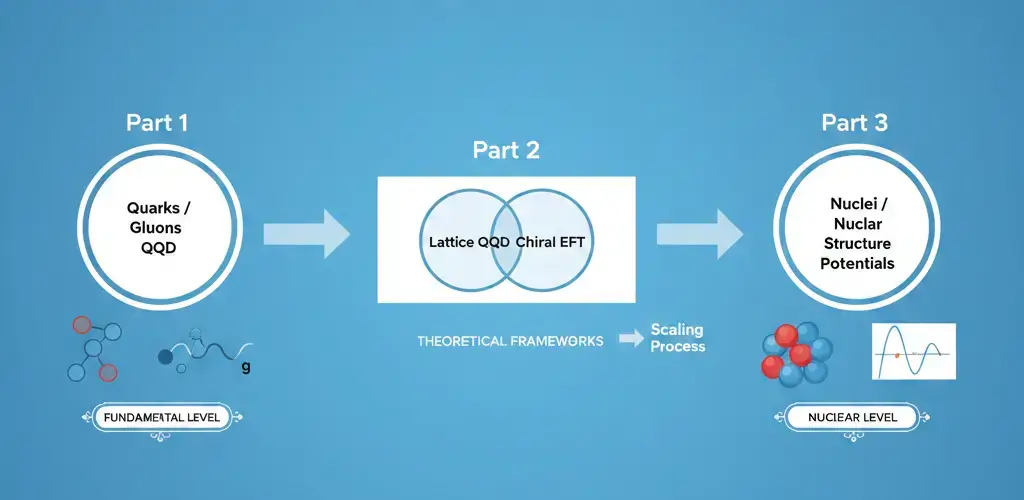
B. How Scientists “Scale Up” the Problem
Physicists came up with some smart workarounds to close the gap between quark-level physics and nuclear physics.
Lattice QCD:
In this method, space-time is broken into a tiny 4D grid—imagine pixel art, but for the universe. Supercomputers then crunch the numbers to simulate how quarks and gluons behave. It is wildly demanding, sometimes taking months of processing on the fastest machines on Earth. Still, it delivers. Lattice QCD has accurately predicted hadron masses, nucleon properties, and even nuclear forces from first principles.
Chiral Effective Field Theory (EFT):
Instead of tracking every single quark interaction, chiral EFT leans on the natural symmetries of QCD. It builds effective forces between nucleons in a systematic way. This approach pulls in the core physics from the quark level but skips the overwhelming complexity. Think of it as a smart shortcut—a simplified model that keeps the important stuff and leaves out the noise.
Effective Potentials:
These models describe nuclear forces using experimental data, while still being guided by what we know from quark physics. Modern potentials like AV18 and CD-Bonn go beyond simple curve-fitting. They integrate QCD-based constraints, making them more realistic and trustworthy.
C. How Quark-Level Behavior Shapes Nuclear Models
The quark structure of matter influences nuclear science in surprisingly direct ways:
Nuclear Forces:
The residual strong force between nucleons emerges from quark-gluon dynamics. Understanding color confinement helps explain why the nuclear force has a short range (about 1-2 femtometers) and why it becomes repulsive at very short distances—quarks from different nucleons start overlapping, and the system resists further compression.
Binding Energy Predictions:
Precise binding energy calculations require understanding how quark masses, gluon exchange, and QCD vacuum properties contribute to nucleon mass. The fact that a proton’s mass comes mostly from gluon field energy rather than constituent quark masses directly affects nuclear mass predictions.
Nuclear Structure Refinement:
Modern nuclear structure models incorporate three-body forces (where three nucleons interact at the same time) that arise naturally from quark-level considerations. These were not just added arbitrarily, lattice QCD calculations predicted their existence and estimated strength.
Real Places Where Particle Physics Changes Nuclear Science
The insights gained from the quark structure of matter and the properties of leptons are constantly being put to the test, driving innovation across various scientific domains.
1. Neutrinos and Nuclear Reactors
Nuclear reactors are neutrino factories. Every time a uranium atom undergoes fission, the resulting neutron-rich fragments beta-decay, emitting electron antineutrinos. A typical reactor produces about 10²⁰ neutrinos per second—enough that you can detect them kilometers away.
Reactor Monitoring: Scientists now use neutrino detectors for real-time reactor surveillance. Since neutrinos barely interact with matter, they escape the reactor core instantly, carrying information about the fission rate and fuel composition. This enables non-intrusive monitoring—you can literally count neutrinos outside the reactor building to verify what’s happening inside the core.
Neutrino Oscillations: The discovery that neutrinos change flavor as they travel (electron neutrinos morphing into muon or tau neutrinos) revolutionized particle physics and has practical implications. Neutrino oscillation experiments use reactor neutrinos to measure fundamental parameters, while the phenomenon itself affects neutrino detection efficiency in applied contexts.
Detection technology has advanced dramatically. Modern neutrino detectors use liquid scintillators or water Cherenkov detectors to spot the rare interactions when antineutrinos collide with protons, producing positrons and neutrons. The International Atomic Energy Agency even explores neutrino monitoring for nuclear non-proliferation verification.
2. Particle Accelerators and Medical Isotope Production
This is the part where particle physics literally helps save lives. Modern medical isotopes—like fluorine-18 used in PET scans or technetium-99m used in diagnostic imaging—come from particle accelerators.
These machines rely on a deep understanding of nuclear reactions shaped by quark-level physics. They speed up protons or deuterons to very specific energies. Then they fire them into chosen target materials. This impact triggers nuclear reactions that create short-lived, medically useful isotopes.
But here’s the catch: choosing the right beam energy, the right target, and predicting the reaction yield is not guesswork. It requires nuclear models built on the bridge between particle physics and nuclear physics.
Take copper-64, a powerful isotope used in cancer therapy. It’s created by bombarding nickel-64 with high-energy protons. The reaction cross-sections—the probability that a proton will strike the nickel nucleus in exactly the right way—depend on the nuclear forces shaped by underlying quark dynamics.
Here we highly recommend: “The Particle Zoo” by Gavin Hesketh—an accessible book explaining Standard Model particles with humor and clarity, perfect for readers wanting deeper understanding. Available on Amazon.
3. Inside Stars: Nuclear Astrophysics
Stars basically act like giant cosmic labs where particle physics and nuclear science collide on the wildest possible scales. Inside the Sun—and every other star—the fusion reactions that produce energy and forge elements heavier than hydrogen rely on nuclear reaction rates calculated from deep, first-principles physics.
Stellar nucleosynthesis, the process that builds new elements inside stars, depends on knowing how often certain nuclei collide and fuse under intense stellar conditions. These reaction rates hinge on nuclear cross-sections shaped by the behavior of quarks inside protons and neutrons. Because of that, modern researchers now use chiral effective field theory to sharpen these calculations, which then makes our models of stellar evolution way more accurate.
Things get even more extreme when massive stars explode as supernovae. In just a split second, temperatures and densities skyrocket to the point where particle physics becomes absolutely essential. Neutrinos—tiny, almost ghost-like particles—start interacting with stellar matter and influence how the explosion actually unfolds. At the same time, the r-process (rapid neutron capture) kicks in, creating heavy elements like gold and uranium through violent nuclear reactions that push nuclei far beyond their stable limits.
So, to truly understand what’s happening in these environments, we have to connect everything—from quark confinement and gluon dynamics all the way up to nuclear structure and reaction pathways. It’s the full story of matter, squeezed into microseconds inside a collapsing stellar core.
4. Latest Experiments Showing Quark Behavior Inside Nuclei
Modern experiments at places like Jefferson Lab dig deep into the quark structure inside fast-moving nucleons within a nucleus. These setups use powerful electron beams as tiny microscopes. As the electrons collide with individual quarks, they reveal how those quarks are arranged and how they behave.
But scientists found something unexpected. Quarks inside nucleons that are bound in a nucleus don’t act exactly like quarks in free nucleons. This shift—known as the EMC effect, named after the European Muon Collaboration—shows that the nuclear environment can actually change quark distributions. At first, no one expected this. Even today, researchers are still exploring what causes it and how far the effect goes.
Recently, experiments have also turned toward bizarre hadrons such as pentaquarks and tetraquarks. These particles contain unusual combinations of quarks, far beyond the simple proton-and-neutron model. While they don’t play a major role in everyday nuclear physics, they help refine our QCD models. And in the long run, those improved models sharpen our understanding of nuclear forces themselves.
Tools and Experiments Unlocking Quarks and Leptons in Nuclear Science
The advancement of particle physics and nuclear physics connection is driven by complex, massive scientific instruments that allow physicists to both collide particles at high energies and measure their resulting decay products with extreme precision.
1. Particle Colliders
High-energy colliders, like CERN’s Large Hadron Collider, smash protons together at almost the speed of light. In those tiny flashes, they recreate extreme conditions where quarks and gluons move almost freely. Because of this, scientists can map quark properties, measure coupling constants, and check whether QCD predictions actually hold up.
Even though colliders don’t study nuclei directly, they still supply the core data nuclear physicists rely on—things like quark masses, interaction strengths, and gluon behavior. These values act as the “starting ingredients” for nuclear models. A famous example is the discovery of the Higgs boson. It helped explain how nucleons gain their mass, which then influences calculations of nuclear binding energy.
2. Fixed-Target Experiments
In fixed-target setups, particle beams are accelerated and fired into a stationary target. This approach is perfect for exploring nuclear reactions that matter in nuclear science. Facilities such as FAIR in Germany and FRIB in the United States produce exotic nuclei and study how they behave.
These experiments measure reaction cross-sections, investigate nuclei with extreme proton-to-neutron ratios, and push nuclear models into conditions we can’t recreate in regular labs. Their results feed directly into real-world applications like reactor design, medical isotope production, and even astrophysical simulations.
3. Detectors, Sensors & Modern Instrumentation
Spotting subatomic particles demands tech that feels straight out of sci-fi. Silicon tracking detectors can trace particle paths with micron-level accuracy. Calorimeters read particle energies by capturing the energy they leave behind. Meanwhile, time-projection chambers record full 3D particle tracks inside gas-filled volumes.
Neutrinos, though, are a whole different challenge. Because they interact so weakly, detectors need massive volumes of ultra-pure material to catch even a single hit. Super-Kamiokande in Japan, for example, uses 50,000 tons of water and an army of photomultiplier tubes to watch for tiny flashes of light from rare neutrino interactions.
All these advanced tools make it possible to collect the precise measurements that link particle-physics theory to practical nuclear-science research.
How This Knowledge Powers Real-World Applications
The connection between quarks and leptons in nuclear science is not purely academic; it forms the foundation for critical technologies used globally.
A. Nuclear Energy
Understanding quarks and leptons directly shapes how we build safer and more efficient nuclear reactors. When nuclear models use QCD-based forces, they become far more reliable. As a result, engineers can design systems that stay stable even in extreme conditions.
Safer Reactor Designs:
Predicting criticality, neutron multiplication, and overall fuel behavior depends on accurate nuclear cross-sections rooted in fundamental physics. Modern reactor simulations pull these values from trusted databases like ENDF, which compile decades of theory and experiment. This foundation helps reactors operate with greater confidence and fewer risks.
More Accurate Nuclear Models:
New reactor concepts—such as molten salt reactors and advanced fusion designs—need models that can handle unfamiliar isotopes. Due to particle-level physics, these predictions stay consistent even when reactors push into unexplored territory. That deeper accuracy gives researchers a clearer path toward future-ready energy systems.
On top of that, neutrino monitoring brings a new safety layer. Because it relies on lepton physics, it allows real-time checks on reactor performance and supports global verification efforts.
B. Medical Imaging & Treatment
Particle physics also fuels major breakthroughs in healthcare, especially in imaging and targeted treatments.
Positron emission tomography relies on isotopes like fluorine-18. When a positron meets an electron, they annihilate and create a pair of gamma rays. Detectors pick up these signals and reconstruct detailed 3D images of metabolic activity. That’s how doctors spot abnormalities long before they appear in traditional scans.
Targeted Radiation Therapy:
Some isotopes, such as lutetium-177, bind to molecules that actively seek out cancer cells. This allows radiation to hit only the diseased tissue. Producing these isotopes demands particle accelerators and precise nuclear physics expertise.
Proton therapy works the same way—just more advanced. It uses accelerator-generated proton beams that deposit most of their energy right inside the tumor. Healthy tissue gets minimal exposure, making this approach safer and more effective. None of this would exist without the foundation laid by particle physics.
Here we highly recommend: “We Have No Idea” by Jorge Cham and Daniel Whiteson—a fun, illustrated guide to the biggest mysteries in physics, including particle physics puzzles. Available on Amazon.
C. National Security
Particle physics and nuclear science team up to power major security breakthroughs.
To start, a deep understanding of nuclear reactions and radiation fingerprints helps scientists build smarter detection tools. These advanced detectors can spot hidden nuclear materials and even identify specific isotopes by reading their unique decay patterns. Because of this, modern homeland security systems respond faster and more accurately.
On top of that, researchers are exploring neutrinos for reactor monitoring. Since neutrinos pass through almost anything, they reveal whether a nuclear reactor is running—even if someone tries to shield it. This could strengthen global nuclear non-proliferation checks and make international agreements more reliable.
All of these advances depend on knowing how quarks form nucleons, how nuclear forces behave, and how weak interactions create detectable particles.
D. Space & Astrophysics
In space science, particle physics and nuclear physics come together even more dramatically. For example, massive stars create heavy elements during supernova explosions. These intense moments trigger rapid nuclear reactions, and modeling them demands precise reaction rates based on QCD-driven nuclear forces.
Likewise, the distribution of elements across the universe—from the abundance of iron to the rarity of certain isotopes—comes from nuclear reaction pathways during the Big Bang, stellar fusion, and supernova events. Understanding these routes helps explain why our cosmic recipe looks the way it does.
And then there’s neutrino astronomy. Instead of watching the universe through light, scientists watch it through neutrinos. This shift opens new ways to observe extreme cosmic events. The neutrinos detected from the 1987 supernova proved how tightly particle physics and astrophysics are linked—and how much more we can still learn.
Visual Timeline: From Early Particle Models to Today’s Nuclear Science
Understanding this journey requires seeing the historical progression of key discoveries:
| Decade | Key Particle Physics Breakthrough | Impact on Nuclear Science |
|---|---|---|
| 1930s | Discovery of the Neutron | Establishes the core components (nucleons) of the nucleus. |
| 1960s | Proposal of the Quark Model | Suggests nucleons have internal structure, paving the way for QCD. |
| 1970s | Formulation of the Standard Model | Provides the theoretical framework for strong and weak interactions. |
| 1990s–2020s | QCD Breakthroughs, Neutrino Discoveries, Lattice Simulations | Confirms neutrino mass; lattice QCD becomes a quantitative tool; new, precise measurements of quark structure. |
| Present | Precision Nuclear Predictions | Utilizing EFT and LQCD for nuclear structure modeling to design new reactors and medical treatments. |
The Future of Particle-Driven Nuclear Science
The journey from the ethereal quarks and leptons to the robust engineering of a nuclear power plant highlights one of science’s most elegant realities: the deepest truths about the universe are connected across every scale.
Today, the connection between particle physics and nuclear physics is stronger than ever. New discoveries about neutrino mass hierarchy will redefine our understanding of leptons. Advances in lattice QCD and chiral effective field theory are moving us closer to building truly ab initio (from first principles) models of the nucleus, leading to:
- Energy: Next-generation reactors with unprecedented safety and efficiency.
- Health: Highly specific medical isotopes and targeted radiation treatments.
- Knowledge: A complete, unified understanding of stellar nucleosynthesis and the formation of elements that make up our world.
The small, dynamic world of subatomic particles is the engine for the future of nuclear science. It reminds us that every time we peer deeper into matter, we gain a more powerful ability to shape our world.
FAQ Section
Quarks determine the properties of protons and neutrons, which directly influence nuclear reaction rates. The strong force between quarks creates residual forces between nucleons that govern how nuclei interact, fuse, or decay. Modern nuclear models incorporate quark-level physics through lattice QCD and effective field theories, improving predictions of reaction cross-sections used in reactor design, isotope production, and astrophysical modeling.
Leptons, especially neutrinos and electrons, mediate weak interactions crucial for nuclear processes. Beta decay transforms neutrons into protons by emitting electrons and antineutrinos. Neutrinos carry information about reactor operations, stellar core conditions, and fundamental physics. Understanding lepton behavior enables neutrino detection for reactor monitoring, medical isotope applications, and probing cosmic phenomena.
Quantum chromodynamics describes the strong force binding quarks into nucleons. This fundamental interaction determines nuclear force characteristics, binding energies, and reaction dynamics. Accurate nuclear models for reactor design incorporate QCD insights through effective theories and lattice calculations. Better QCD understanding leads to improved nuclear data libraries, safer reactor designs, and more efficient fuel utilization.
Medical isotopes are created using particle accelerators that induce specific nuclear reactions. Predicting optimal production conditions requires understanding nuclear forces and reaction mechanisms rooted in particle physics. Accelerator technology itself derives from particle physics research. The connection enables production of PET scan isotopes, cancer treatment radiopharmaceuticals, and diagnostic imaging materials that save lives daily.
Recommended Reads for Curious Minds
If you loved walking through the journey from tiny building blocks to the full structure of the nucleus, then these hand-picked reads will take you even further. They will help you explore the powerful connection between particle physics and nuclear science with ease and excitement.
- Three Roads to Quantum Gravity by Lee Smolin
- Deep Down Things: The Breathtaking Beauty of Particle Physics by Bruce A. Schumm
- Introductory Nuclear Physics by Kenneth S. Krane
- Ab Initio Nuclear Structure and Electroweak Properties from Chiral Effective Field Theory by Patrick J. Fasano
References
- CERN — European Organization for Nuclear Research
- Fermilab — Particle Physics Division
- U.S. Department of Energy – Office of Science
- The Standard Model of Particle Physics
- Nuclear Science Week Resources
- Scientific American & Nature Physics Articles
- Royal Society of Chemistry — Radiation & Isotopes Guides