

The Mediterranean Sea has warm and diverse waters. There exists a subpopulation of the globally recognized Mediterranean white sharks lives there. Unlike oceans, the Mediterranean offers ecological conditions and challenges for these sharks. White sharks inhabit the Mediterranean Sea, which has a unique marine biodiversity that still happens to be a unique living environment for white sharks. Giving contrast to, the adaptations and the behaviors of white sharks in the Atlantic and Pacific Oceans vary. Sheds shed light on how the complex interplay between species and their habitats occurs. Evolutionary History and Adaptation to the Mediterranean Mediterranean white sharks have an exciting evolutionary history. However, genetic studies show differences between these populations and the global populations. For thousands of years, they have adapted to the perfect, semi-closed, nutrient-poor Mediterranean seawater. Unlike their open-ocean relatives, these sharks survive in an environment where temperatures fluctuate seasonally because food resources are scarce. This adaptation, this ability to adapt, has made them the top predator in the region. Physiological Adaptations Mediterranean white sharks exhibit several crucial physiological adaptations: Thermoregulation in Changing Waters These sharks can adjust their body temperature, according to the conditions. This adaptation allows them to survive seasonal fluctuation in the area’s water temperature. Their physiological properties allow them to stay active in cold waters. This ability is important during certain periods of the year. Metabolic Efficiency And slower metabolism means white sharks can live on limited food sources in some parts of the Mediterranean. When prey can be scarce, this efficiency is especially helpful in nutrient-poor areas. Unique Sensory Adaptations Mediterranean white sharks have been found to be very good at finding and navigating by using their senses. They see well in different lighting situations, adapting quickly and effectively. Their acute vision plays a significant role. They are also able to detect electrical fields to find prey, even in murky waters. Diet and Hunting Strategies The Mediterranean white shark’s diet is as varied as the ecosystem you feed them in. The fish prey, while they do hunt squids and seals. They also scavenge on carrion in times of scarcity. However, these powerful jaws have sharp teeth. They are perfectly crafted to break down hard hides, shells, and bones easily. Prey Type Examples Hunting Strategy Fish Tuna, Mackerel High-speed chases Marine Mammals Seals, Dolphins Ambush and stealth attacks Scavenged Carrion Dead fish or mammals Opportunistic feeding Resources in the area can be scarce. They adapt their hunting techniques to the available options in order to survive. Behavioral Characteristics Seasonal Migration Strange migration patterns are observed in Mediterranean white sharks. They travel long distances, both within and occasionally beyond the Mediterranean, in search of food or breeding grounds far from home. The seasonal migration means it takes advantage of these resources. Breeding Behavior These sharks find a place to breed in the Mediterranean. Mating behaviors have evolved so that these worms reproduce in a semi-enclosed sea. But so much about breeding remains a mystery to them, keeping scientists intrigued. Territorial Behavior Territoriality is important in the competitive waters of the Mediterranean. And these sharks defend prime hunting grounds, keeping order and being the ones that get fed. Threats and Conservation Status Mediterranean white sharks face various threats that impact their populations: Overfishing and Bycatch Mediterranean white shark populations have been hugely impacted by human activities. They have been reduced from overfishing and accidentally caught in fishing nets. Their low reproductive rate means they have trouble recovering the population. Pollution Another source of major damage is pollution. The sharks’ health suffers from plastic waste, chemical spills, and other pollutants that reach the marine ecosystem they rely on. Conservation Efforts As many conservationists would have it, they want more strict fishing regulations to protect these magnificent creatures and the legalization of the marine protected areas. The idea is to create a safe haven for white sharks. Unique Predator-Prey Dynamics in the Mediterranean Mediterranean white sharks are critical top predators. Controlling prey populations is a way in which they help to keep an ecological balance. But there are other predators that challenge that as well, showing the fragility of the marine ecosystem. They are important in the health of the Mediterranean Sea because this is a predator-prey dynamic, whereby it requires one animal relying on others. Insights from Recent Research New insights into Mediterranean white sharks have been provided by recent studies. Studies of genetic make-up have shown that these populations are very different from other white sharks around the world. But advanced tagging and tracking technologies have also revealed what they have been doing, and it’s helped researchers understand how they behave. Mediterranean countries are making great strides by cooperating internationally in shark research and conservation. Public Perception and Misconceptions But white sharks have a frightening reputation because of myths and misconceptions. They are misconstrued by many as aggressive or dangerous. In actuality, though, they are necessary components of the marine ecosystem and are hardly ever dangerous to humans. Education and awareness campaigns are driven by these myths to help ameliorate fear without reason and to enable coexistence. Future of Mediterranean White Sharks And these sharks will depend on solving current challenges to survive in the future. For example, their habitat and their prey will be changed due to climate change. For their survival, major expansion of marine reserves and use of highly effective conservation policies are essential. Together we can safeguard these magnificent giants to live in the Mediterranean Sea for as long as possible. “The greatest danger to our future is apathy.” — Dr. Jane Goodall
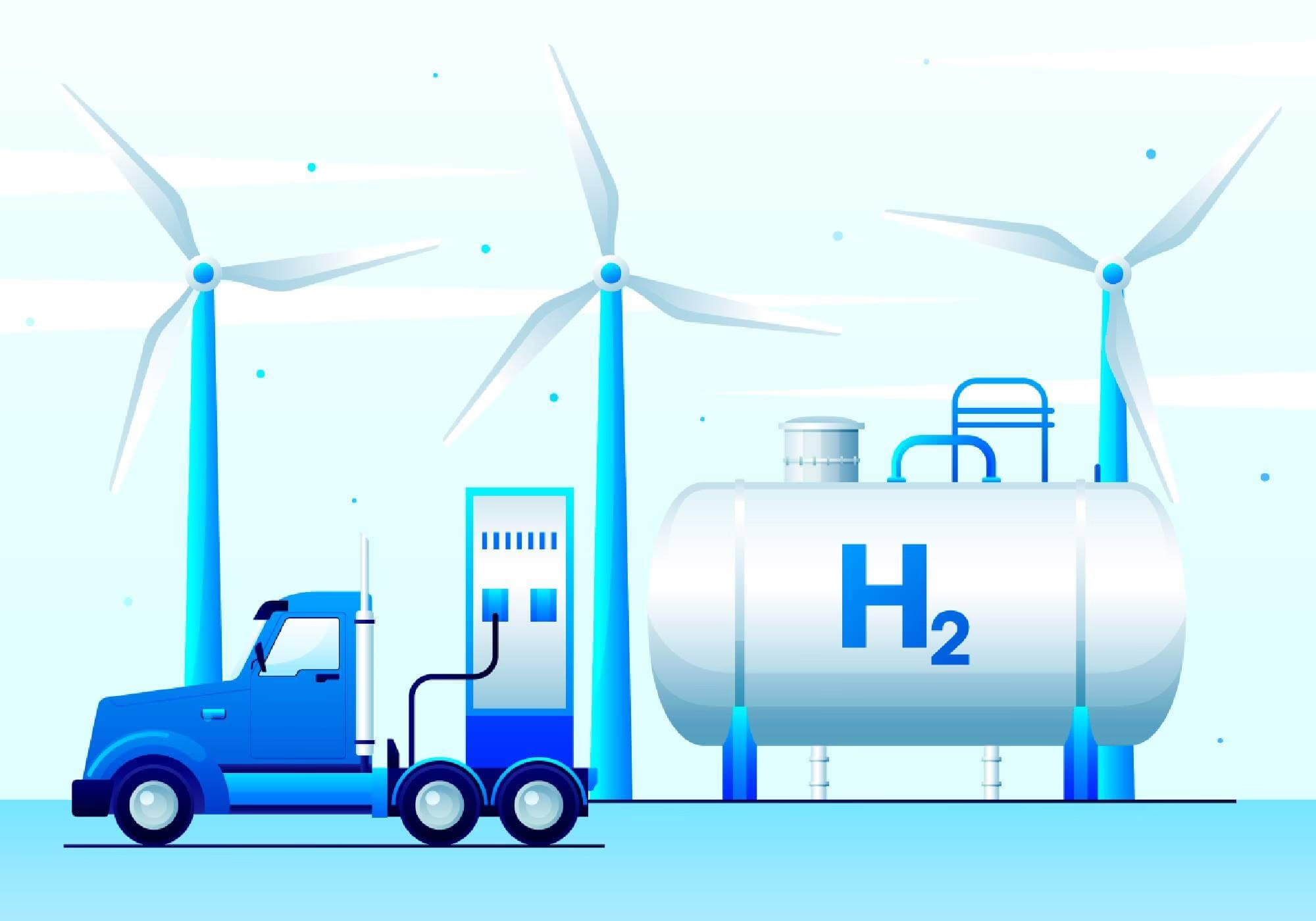
Green Hydrogen Production: Explore the Benefits and Challenges
Did you know that green hydrogen could power entire industries with zero emissions? Green hydrogen production is rapidly becoming one of the world’s hottest solutions to the world’s search for clean energy. With countries around the world strive to reduce their carbon emissions, hydrogen is becoming a potential game changer. So what is it that makes clean hydrogen energy so special? How can it aid us in moving toward a sustainable future? In this blog, we will explore the science behind green hydrogen production. We will explore its advantages and drawbacks step by step. Finally, we will understand why it is gaining so much attention today. Green Hydrogen: The Fuel of the Future? Green hydrogen represents a new and advanced way of using hydrogen for energy. It is created by harnessing renewable energy sources like wind or solar power. Sustainable hydrogen is unlike traditional means of hydrogen production, which release harmful emissions. Grey hydrogen comes from fossil fuels, while blue hydrogen captures and stores carbon emissions. The Process Behind Green Hydrogen Electrolysis Electrolysis, powered by renewable energy, splits water into hydrogen and oxygen, creating a carbon-free fuel. In this process, a process that uses electricity to separate a bond and break water (H₂O) bonds to create hydrogen (H₂) and oxygen (O₂). The whole process remains carbon free when the electricity is from renewable sources, such as solar or wind. Renewable Energy and Electrolysis In order for electrolysis to be viewed as self-sustaining, it will have to use clean energy sources. In that case, wind and solar energy are the best options, as they don’t emit any harmful pollutants. So this mode of production not only provides a tool to harness the excess energy from such sources but also assists in global energy requirements without dependence on fossil fuels. Methods of Green Hydrogen Production Electrolysis Techniques There are different methods of electrolysis, and each one has its own benefits. Comparison of Electrolysis Methods Method Efficiency Cost Scalability Alkaline Electrolysis Medium Low High PEM Electrolysis High High Medium Solid Oxide Electrolysis Very High Very High Low Each method has its advantages and disadvantages. For example, PEM electrolysis is more efficient but more costly. Alkaline electrolysis costs less but delivers lower efficiency. Environmental Impact of Green Hydrogen Clean hydrogen energy can play a large role in mitigating climate change. Here is why: Toyota’s Hydrogen-Powered Mirai Toyota’s Mirai vehicle, which it calls the revolutionary green hydrogen vehicle, exemplifies its commitment to green hydrogen. Hydrogen fuel cells drive Mirai, meaning “future” in Japanese. It’s a car that combines hydrogen and oxygen to make electricity, so the vehicle runs and produces nothing but water vapor. That means each full tank in the Mirai will yield a range of about 400 miles, which puts its potential as a hydrogen fuel into contention with traditional fuels. Such innovation by Toyota, one of the world’s leading vehicle manufacturers, shows the astounding versatility of hydrogen as a means to reduce transportation emissions. It also points to the need for global hydrogen refueling infrastructure; the company is looking to tackle this head-on, working with governments and other industries to create this. Applications of Green Hydrogen Energy Storage Energy storage requires green hydrogen. It allows us to store surplus renewable energy that we can tap later when demand is high or renewable generation is low. This solves one of the key problems with renewable energy: its intermittent nature. Transportation Hydrogen fuel cells are starting to be used in many hydrogen-powered vehicles, including buses, trucks, and even cars. These vehicles emit only water vapor, so these are a fantastic alternative to conventional petrol and diesel vehicles. Industrial Uses Green hydrogen can be a cleaner feedstock for industries like, for example, ammonia production. Hydrogen is also used in refineries to reduce carbon footprint with cleaner fuels. Power Generation Mixing hydrogen into natural gas pipelines can slash power plant carbon emissions by an order of magnitude. That makes this a gradual transition to a cleaner energy system with no need for a complete infrastructure overhaul right now. Challenges in Green Hydrogen Production While green hydrogen presents a promising future, there are still several challenges to address: Innovations and Emerging Technologies Researchers are trying to make green hydrogen production more efficient and affordable. Here are some innovations on the horizon: Global Initiatives and Policies Green hydrogen is the focus of big investments across the world. For instance: In addition, governments are offering subsidies for research as well as large-scale production facilities to create an incentive for sustainable hydrogen infrastructure. The Future of Green Hydrogen This is being done as the world fights to achieve net-zero emissions by 2050, and sustainable hydrogen will continue to become ever more important. It could be used to decarbonize some of the toughest sectors and replace fossil fuels in critical industries. Within the next few years, green hydrogen may well form an integral part of the global energy mix. Quote by Albert Einstein: “As Albert Einstein once said, solving modern problems requires innovative thinking. Green hydrogen embodies this principle perfectly.” It clearly shows the pressing needs for alternative solutions, such as green hydrogen, to resolve global energy concerns. FAQ Section:
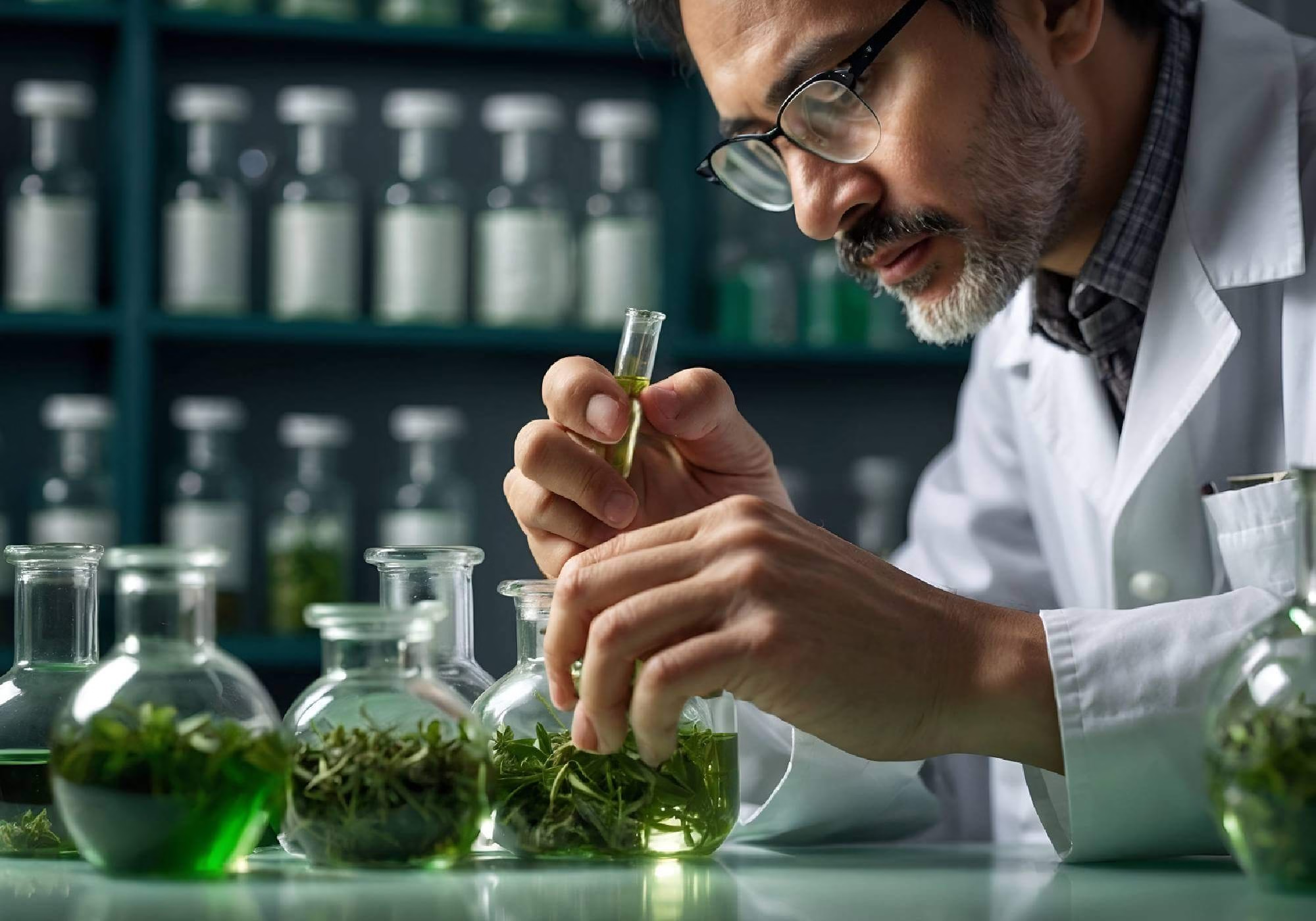
Ancient DNA: human evolution – Discoveries, insights, examples
Do you have any idea where we came from? Like any exploration of human evolution, this journey only gets more interesting with the introduction of ancient DNA investigations. This scientific discipline has turned into a treasure trove. It has enabled us to piece together the stories of our ancestors. It has provided us valuable information. This information is valuable, not just within the remit of forensic science. It also extends within the wider sciences’ hierarchy. In this article, we will examine the role of ancient DNA. It helps us find out where our ancestors come from. It also reveals how they lived and interacted. The Rise of Ancient DNA Studies What Is Ancient DNA? Ancient DNA is the genetic material extracted from preserved biological samples like ancient bones, teeth, or tissues. The procedure is innovative. It enables the scientists to analyze genetic sequences. These sequences have remained undisturbed for thousands or even millions of years. It is a precision game to extract antique DNA. Scientists carefully peel layers of DNA from fossils found in caves, or even frozen tundras. These tiny samples are now amplified by modern technologies so that researchers can reconstruct genomes of extinct species. This breakthrough reveals powerful new clues. It sheds light on how humans migrated from one continent to another. It also shows how they came into contact with other creatures, like Neanderthals and Denisovans. Fundamental techniques used in obtaining and studying ancient DNA: Why Ancient DNA Matters Understanding ancient DNA is crucial for several reasons: The Oldest Family Tree Ancient DNA research has revealed surprising details about our ancestors. Here are some historic findings: Discovery Impact on Human Ancestry Neanderthal DNA Modern humans share about 1-2% of their DNA with Neanderthals, proving interbreeding occurred. Denisovan Genome Showed that another human species coexisted with and interbred with our ancestors. Cheddar Man’s DNA Revealed early Britons had dark skin, challenging stereotypes about ancient populations. The integration of these ancient human species and their role in shaping the modern human genome is these findings. How Scientists Use Ancient DNA to Decode Human History Reconstructing DNA from ancient remains became possible with human-invented advanced technologies like next-generation sequencing. The data is used by scientists to map the relationships between species that reveal how genetic traits arose. For example, the study of ancient DNA has informed us about how the early humans mastered living in harsh climates. It also shows what type of disease immunity they developed. Famous Ancient DNA Projects Several projects have made headlines by sharing remarkable details about human history: “The past sets the stage, and with ancient DNA, we uncover humanity’s story using fresh tools.” The Impact of Modern Technology Advancements in DNA Analysis Technological innovations have propelled ancient DNA studies ahead. Key advancements include: Ethical Considerations As exciting as this research is, it brings with it ethical implications: Conclusion Studying ancient DNA is like uncovering the layers of history, piece by piece. We see the fine details human evolution began to reveal in time before. Already, genetic data narratives are uncovering familial connections, helping us to understand adaptations. Our ancestors teach us important lessons as we move ahead into the future. These lessons emphasize a shared heritage. We are all linked as humans in one way or another. Think not just of your family’s roots. Consider the expansive story of humankind. It is not just written on our bones but also comes from a shared, universal DNA. As we learn to unravel our ancestral DNA more, we are telling a story. This story pays homage to our ancestors. It also sets us on course for the future.

Master Bernoulli Probability Distribution: Simplified Formula for Beginners
Many statistics students often feel anxious when they hear the term ‘probability distribution’ in class. I have seen this happen dozens of times in my classroom. Yet, I discovered that the Bernoulli probability distribution formula is one of the simplest concepts in statistics. It has a yes or no outcome. The Bernoulli distribution formula calculates the probabilities for events with just two outcomes, success or failure. People use it without knowing. This happens when predicting rain tomorrow or checking product quality standards. Let me explain the Bernoulli probability distribution through the examples you may experience each day. This article breaks down the formula into manageable segments. You will see practical Bernoulli distribution examples ranging from weather forecasts to medical tests. The calculation methods will make it feel like simple arithmetic. What Is Bernoulli Probability Distribution? In simple terms, the Bernoulli distribution models a single event with two outcomes: success (1) and failure (0). Every event comes with a chance of success or failure. Each outcome has its own probability. This is a perfect tool for analyzing events with just two possible outcomes. A student takes a stat class where one outcome is ‘success’ (1) and the other is ‘failure’ (0). The applications of this concept stretch across many everyday scenarios: The Bernoulli distribution formula consists of two essential components: p (for probability of success) and q (for probability of failure, i.e., 1 – p). An outcome has to be guaranteed, and these probabilities must add up to 1. This distribution is one that I love. It feels like a special case of a binomial distribution with only one trial. But it gives us a simple concept by which we can construct more complicated probability models effectively. Its elegance lies in this distribution’s approach. It presents the reader with a simple method for addressing yes and no questions. It also provides a way to calculate their probabilities. The Bernoulli probability distribution helps us to understand the binary choices that form much of our daily lives. These range from coin tosses to factory quality checks to game predictions. Important features of Bernoulli Probability Distribution I would like to discuss some interesting things about the Bernoulli distribution formula. This will spawn a revolution in probability theory. The two simplest elements of this distribution are the starting point for understanding what this distribution is. Probabilities of success and failure The Bernoulli distribution consists of two distinct probabilities: You probably have to go elsewhere; these probabilities must add up to 1… (perfect sense!) Something happened! An 80% chance of success is mutually exclusive with a 30% chance of failure. Just like the numbers have to balance exactly. Basic mathematical notation The Bernoulli distribution uses a simple formula with a probability mass function (PMF). It looks like this: f(k;p) = p when k=1 and 1-p when k=0. Our distribution’s mean (expected value) equals p, and the variance comes out to p(1-p). The sort of thing I love about the variance is that it stays between 0 and 0.25. This acts like a safety rail for our calculations! This distribution fits perfectly with real life yes/no questions. Simple mathematical tools helps in to make sense of uncertain situations, from calculating game-winning odds to predicting tomorrow’s weather. Practical Formula Applications I will tell you some interesting ways that I use the Bernoulli probability distribution formula in real life. It is a simple, but powerful tool used to help us make better decisions, moment by moment. 1. Weather prediction examples My work with weather forecasts involves using the Bernoulli distribution to calculate rain chances. Weather models employ this distribution to predict daily rainfall. They mark each day as either rain (1) or no rain (0). The meteorologists I work with say that these predictions help them plan floods and manage water reservoirs effectively. 2. Medical testing scenarios Throughout that process, I have collaborated with medical professionals using the Bernoulli distribution to track patient outcomes during clinical trials. When the teams test the new drugs, they mark each treatment as (1) if it was successful. Otherwise, they mark it as (0) if not. Amounts of these calculations help solve positive process probabilities and steer choices in the identification of the effectiveness of treatment. 3. Quality control in manufacturing Here is something interesting from my time at a light bulb factory: The Bernoulli distribution formula helped in to predict the number of bulbs that would pass inspection daily. Manufacturing teams use this to: This simple mathematical tool makes a remarkable difference in various industries. The Bernoulli probability distribution appears in unexpected places, from predicting tomorrow’s weather to testing new medical treatments. Formula Practice Problems Let’s solve some real world Bernoulli distribution problems together! These are the best practice issues that I used to learn this concept during my statistics trip. Beginner level exercises Students love the light bulb quality test issue. Testing bulbs with a 90% pass rate means marking each working bulb as 1 and each failed bulb as 0. This exercise helps you learn the simple concepts of success probability (p) and failure probability (1-p). Solution walkthrough examples Here is a coin toss issue from my class. Tossing a coin 10 times and calculating the probability of getting at least seven heads becomes clear with these steps: Self-assessment questions Test your skills with these questions: These practice problems help my students feel more comfortable with the Bernoulli probability distribution formula. Simple probability calculations are followed by real life applications of each solution, which are built on previous concepts. Conclusion I still believe that the Bernoulli distribution formula is one of his favorite mathematical tools, since it simplifies complex probability calculations. Through teaching, I transformed students’ fear of probability distribution problems into confidence. They now approach problems with assurance on the ground! My students told me they love how the formula is broken into manageable pieces. It simplifies to p for success and 1-p for failure. It is such a simplicity that allows us to analyze anything from coin flips