

Parkinson’s disease (PD) affects thousands of people each year in a way that changes their lives. Not only patients find it difficult, but so do their families. But new research is exciting and still offers real hope. The good news is that scientists are making progress in genetic research. This someday will slow down the Parkinson’s. It eventually stops the disease. Researchers want to “walk that fine line,” target specific genes, and fix the root causes. According to this blog, tools like CRISPR and gene therapy have significant implications. They open a new path toward treating PD. This promises a better quality of life. Parkinson’s disease often results from multiple causes rather than one. There are certain lifestyle factors and environmental triggers that we can change. Nonetheless, in families where Parkinson’s is a genetic problem, genetics usually plays a bigger role. There are certain genes that cause a person to develop Parkinson’s symptoms, like LRRK2 and SNCA. But when these genes are mutated, brain cells can be triggered to destroy themselves, leading to the symptoms of PD. Today, scientists try to correct these genetic mutations before symptoms become obvious. The Power of DNA Engineering in Treatment Most conventional Parkinson’s treatments can be used to manage the symptoms. Yet, they do not actually tackle the root causes of the disease. Still, DNA engineering opens up a whole new world of slowing or even stopping the disease. Read about some of the techniques researchers are using to do this. 1. CRISPR CRISPR is one of the most effective tools available today. It allows scientists to insert themselves into DNA. This process helps to fix errors. CRISPR is like a small and very precise tool. You can use it to cut out the faulty part of a gene sequence. CRISPR helps cut out rogue mutations in Parkinson’s patients and replace them with healthy gene sequences. It is precise. It is effective. Furthermore, it offers hope for long-lasting effects. It is also said to have fewer side effects in the future. 2. Gene Therapy Another powerful tool, and that is gene therapy, which allows doctors to repair or replace faulty genes. People with Parkinson’s lack a chemical called dopamine in their brains. Some gene therapies try to restore it. This uses gene therapy to achieve a greater and longer-term effect against Parkinson’s disease. It treats the root of the disease instead of just treating the symptoms. Researchers are keeping their fingers crossed as they show positive results. What This Means for Future Treatment If these genetic therapies move ahead, the future of Parkinson’s is bright. By fixing the disease’s root cause, patients will get therapies. These therapies would not have to counteract symptoms managed with daily medication. Second, genetic treatment will be customized so that patients get personalized treatments for their individual genetic features. This would also mean better, safer care. Despite all the positive signs, these treatments pose challenges. Scientists are trying to reach the desired gene. The hard part is delivering the treatment directly to brain cells. But these are questions that current clinical trials are working on to protect patient safety and efficacy. As we learn more, hopefully these treatments will become safer and more available. How Patients and Families Stand to Gain But these genetic developments are particularly positive news for patients and families suffering from Parkinson’s. This future offers the possibility of treatments that can delay or prevent the disease. These treatments give more independence and a greater quality of life. Patients also have the opportunity to join in this research through large clinical research studies and before the rest. Research is moving so quickly that it can be hard to keep up. Organizations like the Michael J. Fox Foundation and the Parkinson’s Foundation offer reliable updates on clinical trials and the latest studies. These organizations also give support for families and patients, creating a valuable network for anyone affected by PD. Conclusion But this is about making a real difference for patients with Parkinson’s disease: genetic research for patients. CRISPR, DNA engineering, and gene therapy will speed up our progress. They will lead us to a future where Parkinson’s is finally cured at its roots. We are still a long way off. Yet, science is moving ahead. It helps us get closer to a better future for people with PD and their families.

Master Post Quantum Cryptography to Secure Your Data
Thus, quantum computing signifies a revolution in data security! Quantum computers carry out calculations much, much faster than conventional computers. The speed it offers poses a huge risk to our data security. Enter the era of post quantum cryptography. Its goal is to secure our data from future quantum attacks, keeping us safe in the virtual world. Quantum Threat Quantum computing changes everything when it comes to computation. It does this through the use of qubits (quantum bits), which can solve complex equations faster than traditional computers. This new power is capable of cracking traditional encryption measures. For example, algorithms like RSA and ECC encrypt online banking as well as people’s communications at an individual level. But these are not capable of withstanding the changes that quantum computers bring. These algorithms be cracked by a quantum machine in seconds, leaving your personal and financial data vulnerable. It’s worse than just individuals. Companies use encryption to protect customer data. Nobody wants a hacker to break into their systems. This leads to financial losses and legal troubles. It can also damage the organization’s reputation. As quantum computers advance, it’s important to understand why we need post-quantum cryptography. Need for Post Quantum Cryptography It is a form of post-quantum cryptography, which means it involves algorithms that are considered secure against quantum attacks. It is because of these algorithms that, even in a world with quantum computers, our private data remains secure. Traditional cryptographic techniques are good enough for now, yet they become obsolete very quickly. These systems can be weakened by quantum computers, so post-quantum solutions are necessary to protect our data. As the quantum future approaches, we must rethink our security mindset. This includes building new quantum-resistant algorithms. Companies should really spend money on research to make data more secure and gain the trust of users. Principles of Post Quantum Cryptography There are several core principles guiding post-quantum cryptography. Here are some of the main ideas: 1. Quantum Resistance It is vital for algorithms to withstand potential attacks from quantum computers. This ability is vital to maintaining data security moving ahead. 2. Algorithm Diversity Using different algorithms helps reduce the risk of a single point of failure. Organizations should avoid relying on only one solution; a diverse strategy is essential. 3. Compatibility with Existing Systems Post-quantum algorithms need to work seamlessly with existing systems. Ensuring a smooth transition without significant disruptions is crucial for continued operations. Popular Post Quantum Cryptographic Algorithms Various promising algorithms are emerging in post-quantum cryptography. Here are some examples: These algorithms bring unique advantages and are crucial for effective post-quantum cryptography. Organizations should evaluate these options and choose the ones that best suit their specific security needs. Implementing Post-Quantum Cryptography Switching to post-quantum cryptography requires careful planning and implementation. Organizations can take the next steps: By adopting post-quantum cryptography, businesses can protect their data and build trust with customers. Furthermore, taking these proactive steps shows a commitment to security, which enhances a company’s reputation. Future of Data Security As quantum computers become more powerful, the way we keep data secure will inevitably change. Thus, organizations must be proactive in adopting post-quantum cryptographic systems. By prioritizing security measures, businesses can keep their data safe from future threats. The journey to post-quantum security is ongoing and requires commitment and continuous improvement. In this ever-evolving landscape, security is not a one-time effort; it is an ongoing process. As Bruce Schneier wisely stated, “Security is not a product, but a process.” This quote highlights the need to stay vigilant and adapt to new threats as they emerge. References
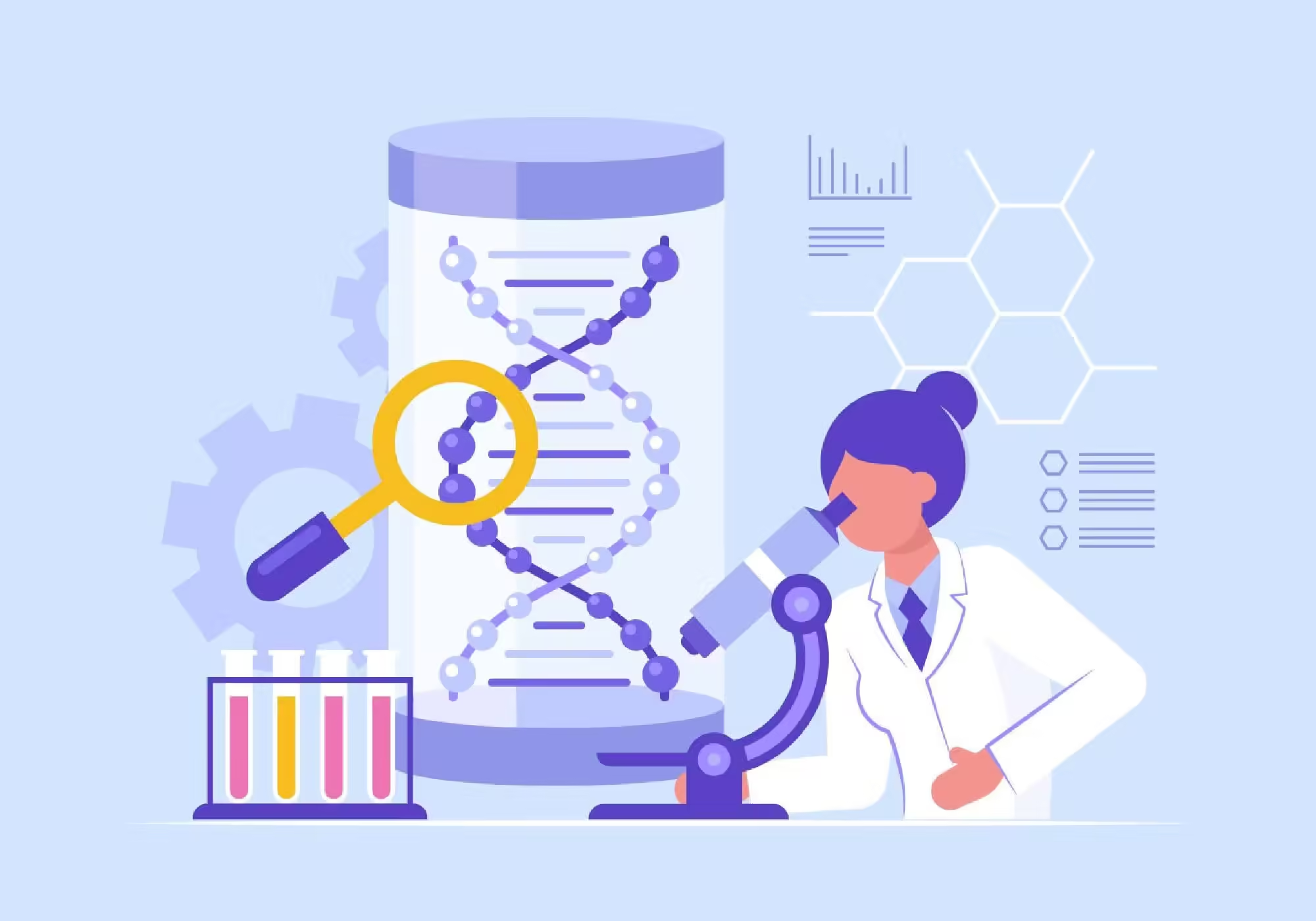
Synthetic Biology: Simplified DNA Engineering & Genetics
Synthetic biology is the convergence of engineering and life science, allowing the precise programming of living systems. Learn how the Design-Build-Test-Learn (DBTL) cycle is simplifying DNA engineering to create sustainable chemicals, next-generation medicines, and even entirely new life functions.

How Waste-to-Energy Powers Cost-Effective Water Treatment
Water treatment is a very important and commonly overlooked process, and its energy intensity can be very significant. Thankfully, there is a technology that is not only reducing these costs but also helping the environment: waste-to-energy water treatment. These can be called innovative because they help convert industrial waste into electricity. This conversion improves the cost-effectiveness of water treatment plants. It always amazes me how great ideas can bring about change. Waste-to-energy is an example of that. It is energy efficient. This process allows many industries to deal with their waste. They produce clean water at the same time. All of this happens in the process of reducing costs. So, let’s see how it works. Turning Industrial Waste into Energy When people think of industrial waste, they think of landfills or pollution. But that waste can actually be a resource used very effectively. Anaerobic digestion is a process. It turns organic matter, like food scraps or plant matter, into a gas called biogas. This biogas is recoverable and can be used as fuel. For water treatment plants, this means they can generate electricity to supply their plants. They use the waste they generate or the waste from nearby industries. They use local power generation and do not rely on power from an external grid. This approach has significantly reduced costs. This change is easy to think about, but in reality, it is crucial. In fact, here is how that waste can be used to power the treatment, and save the facility money while doing so: The Financial Upside of Waste-to-Energy Let’s talk numbers. Energy is one of the biggest expenses for any water treatment facility. But when you convert waste to energy, you’re cutting down on the amount you need to buy from traditional sources. And that reduction can be significant. Here’s why: This way, water treatment plants reduce their operating costs, allowing more money to flow into the business. And who would not want that? Environmental Benefits of Waste-to-Energy Well, now I love the concept of business and the environment complementing each other. Waste-to-energy systems do just that by providing an even cleaner source of energy than fossil fuels. Such systems reduce the amount of waste buried in landfills. They emit fewer greenhouse gases by using waste that would otherwise be a pollutant. Here’s a simple description of the environmental benefits: Advantage Impact Less waste sent to landfills Reduces environmental contamination Fewer emissions Lowers carbon footprint Renewable energy source Replaces fossil fuels It is a win-win for both the planet and the industries using this technology. Success Stories of Waste-to-Energy Before I discuss waste-to-energy systems in detail, I’d like to share two success stories. These are not small ideas on paper, they are happening today, and they are changing the world. 1. California Water Treatment Facility This plant integrated a waste-to-energy system and cut their energy costs by 40%. Using biogas produced from organic waste, they now generate enough energy to run their entire operation. It is incredible to see such a huge reduction in energy costs while maintaining efficiency. 2. Denmark’s Biogas Powerhouses In Denmark, food waste collected from households and restaurants is separated. It is then converted into energy through a process called bioenergy conversion. This energy is used to run water treatment plants. Some of it is also fed into the electricity grid. It’s a very basic idea, but it has very serious consequences. The next examples show how waste-to-energy production has played a vital role in sustainable water treatment. It also contributes to sustainable cost management. “Waste is only waste if we waste it.” — Will.i.am Future Potential of Waste-to-Energy Water Treatment The potential here is huge. As more industries adopt waste-to-energy systems, we will see a change in the way water treatment plants operate. In fact, governments and environmental agencies are already offering incentives to attract more companies to this technology. I really think this is the future of water treatment. It’s not just about saving money, it is about creating a system that works for the environment too. Conclusion Water treatment has always been energy intensive, but with waste-to-energy systems, this is starting to change. By converting industrial waste into energy, companies can save costs, reduce their environmental impact, and create more sustainable operations. If industries continue to adopt this method, the future will change. Waste will not just be waste. It will become a powerful resource.