

Imagine if building the perfect neural network didn’t demand years of experience or endless trial and error. Neural Architecture Search is making that idea real. It automates the way machine learning models are designed. Instead of manually adjusting layers, connections, and hyperparameters, NAS explores thousands of possible architectures on its own. The goal is simple: find the best design for a specific task. For a long time, neural network design has been both an art and a science. Engineers relied heavily on intuition, experience, and repeated experiments. However, as models became deeper and systems more demanding, this manual process started to fall short. At this point, NAS steps in and changes the approach entirely. It treats network design as an optimization problem—one that machines can systematically solve. This shift marks a major milestone in the evolution of AutoML. By automating one of the hardest parts of model development, NAS lowers the barrier to advanced machine learning. As a result, more people and organizations can build powerful models faster. Whether the goal is higher accuracy, faster inference, or better efficiency on edge devices, NAS provides a clear and structured path forward. The benefits go far beyond saving time. In fact, NAS has already produced architectures that outperform human-designed models on benchmarks like ImageNet. Even more impressive, many of these models use fewer parameters and run faster. By exploring design combinations humans might never think of, NAS doesn’t just replicate expert knowledge—it often pushes past it. Neural Architecture Search Core Concepts Explained Understanding neural architecture search starts with three core components that work together to automate model design. These elements act as the foundation of every NAS algorithm. No matter the method, each approach builds on these same basics. Search Space: Defining Architectural Possibilities The search space defines which architectures NAS is allowed to explore. Think of it like a vocabulary. NAS uses this vocabulary to build neural networks, just like words form sentences. If the search space is too small, creativity suffers. New and better designs get missed. On the other hand, if it’s too large, the search quickly becomes expensive and slow. So, a good search space finds the sweet spot. It stays expressive, yet manageable. Primitives are the basic building blocks inside this space. These blocks tell NAS what it can use while designing a network. Common primitives include convolution layers with different kernel sizes, pooling layers, skip connections, and attention modules. Today’s search spaces go even further. They often include advanced operations like depthwise separable convolutions and inverted residual blocks. These choices matter because they are already proven to work well in manually designed models. Search spaces can be divided into macro and micro levels. The macro search space looks at the big picture. It decides how many layers the network should have, how blocks connect, and how information flows overall. In contrast, the micro search space zooms in. It focuses on designing small units, called cells, that are repeated again and again across the network. This cell-based idea became popular with models like NASNet. It works well because NAS searches a smaller space first. Then, it reuses the best cell design to build larger networks. As a result, you still get diverse architectures without exploding the search cost. In practice, a macro search might allow anywhere from 5 to 20 layers with flexible connection patterns. A micro search, however, finds one strong cell and stacks it multiple times using fixed rules. Both strategies have clear trade-offs. Macro search gives more freedom but grows exponentially harder to explore. Micro search is faster and more efficient, but it limits variety due to repetition. In short, the choice between macro and micro search depends on your goals. Do you want maximum flexibility, or faster and cheaper discovery? The right answer often lies somewhere in between. Search Strategies: How Algorithms Explore Architecture Space Once you know what can be built, the next step is figuring out how to search that space smartly. This is where NAS methods really start to differ. Each approach follows a unique strategy and demands a different level of computational power. Reinforcement learning–based NAS frames architecture search as a step-by-step decision process. Here, an agent—often a recurrent neural network—builds a model layer by layer. After generating an architecture, the model is trained and evaluated. Its validation performance then becomes a reward signal. Over time, the agent learns which design choices lead to better results. Google’s original NAS work followed this path, using a controller RNN to predict layers and connections. Although this method is effective, it comes at a high cost. Thousands of candidate networks must be fully trained, which makes it extremely resource-intensive. Evolutionary approaches borrow ideas from natural selection. Instead of a single agent, they work with a population of architectures. Each one is evaluated for performance, and the strongest candidates are kept. New architectures are then created through mutations and crossovers. For example, a mutation might change a layer type or add a skip connection, while crossover mixes parts of two strong models. Methods like AmoebaNet have produced impressive results. However, they still rely on heavy computation to explore the search space. Gradient-based NAS marks a major shift toward efficiency. Rather than making hard, discrete choices, these methods turn the search space into a continuous one. Techniques like DARTS assign learnable weights to all possible operations. During training, gradient descent naturally increases the importance of useful operations and suppresses weaker ones. Because this process uses standard backpropagation, it dramatically cuts search time. What once took thousands of GPU days can now be done in just a few. In the end, the final architecture is formed by selecting the operations with the highest learned weights. Overall, the key difference between these NAS strategies lies in how they balance search power and efficiency. Some aim for maximum flexibility, while others focus on speed and practicality. Performance Estimation: Evaluating Architectures Efficiently The most expensive part of Neural Architecture Search is figuring out how good each candidate

How Geological Complexity Index Transforms Landslide Risk Modeling and Prediction
The ground beneath our feet may seem stable, but in many regions, it is constantly shifting. As climate change speeds up and cities expand into hilly and mountainous areas, landslides are happening more often and with greater force. This growing threat calls for smarter and more reliable tools to understand natural hazards. For years, most risk models have focused on surface factors like slope angle and rainfall. While useful, these models often overlook what lies deeper below the surface—the geological “DNA” of the land. As a result, their predictions can fall short. This is where the geological complexity index (GCI) makes a real difference. Instead of relying on a few basic variables, GCI uses a multi-parameter approach. It considers tectonic history, variations in rock types, and the strength of underground structures. By connecting these deeper factors, the geological complexity index is reshaping landslide risk modeling. It is also helping scientists predict hazards with greater confidence and clarity. Why Geological Complexity Index Matters Now We are now living in the age of cascading disasters. One heavy rainfall no longer causes just a flood. In high-altitude or geologically active regions, it often sets off a chain reaction. Slopes collapse. Land shifts. Entire landscapes fail in sequence. For decades, scientists focused mainly on the trigger. Rainfall. Earthquakes. Extreme weather. Meanwhile, the ground beneath was treated as something stable and uniform. But thanks to modern remote sensing and GIS modeling, we now know that assumption was wrong. The Earth is not uniform at all. It is layered, fractured, and constantly evolving. This is where the Geological Complexity Index comes in. It offers a way to measure the hidden “inner chaos” of the terrain. Yes, a steep slope is risky. But a steep slope made of fractured limestone, resting on an active fault line, is far more dangerous. GCI captures this difference. It assigns a numerical value to geological complexity, adding a deeper and more realistic dimension to landslide risk assessment. And this matters now more than ever. Traditional models are reaching their limits. Adding more rainfall data alone no longer improves predictions significantly. To truly boost accuracy, we need to understand how complex the ground itself is. GCI is not just another tool for terrain research. It is becoming a life-saving foundation for the next generation of early warning systems. What Is the Geological Complexity Index? At its core, the geological complexity index measures how unstable a geological environment really is. It does not rely on a single data point. Instead, it brings together several high-impact factors into one clear metric. In other words, it looks at the big picture. It helps explain how a landscape is likely to behave when pressure builds. As stress increases, this combined view makes it easier to understand why some areas fail while others remain stable. The Four Pillars of GCI To understand GCI, we have to break it down into its constituent components. Think of these as the “ingredients” that define the volatility of the terrain: How GCI is Calculated Calculating the GCI is a feat of multi-parameter modeling. It typically utilizes the Analytic Hierarchy Process. In simple terms, AHP is a structured technique for organizing and analyzing complex decisions. Researchers take data from Digital Elevation Models, satellite imagery, and field surveys, then assign “weights” to each pillar. For example, in a region known for massive earthquakes, the seismicity component might be weighted more heavily than lithologic diversity. By combining these weighted factors, we get a single, powerful index that represents the total geological “stress” of the area. How GCI Improves Landslide Risk Modeling The evidence is clear in the data. Recent breakthroughs back this up. One standout example is Zhang’s study on landslide susceptibility in mountainous reservoir regions. The research shows that adding the geological complexity index greatly improves prediction accuracy. In fact, it outperforms traditional models by a noticeable margin. Case Evidence: The Zhang Study Effect In many traditional landslide risk modeling scenarios, the “Area Under the Curve” (AUC)—a standard metric for model success—often hovers around 0.7 to 0.8. However, when Zhang and his team integrated GCI into their hazard evaluation, the predictive power often jumped into the 0.85–0.92 range. Why the massive jump? Because traditional models often struggle with “false positives” (predicting a slide where none occurs) or, more dangerously, “false negatives.” GCI refines the model by explaining why two identical-looking slopes behave differently. One slope might have a GCI of 0.3 (stable), while another—due to hidden faulting—might have a GCI of 0.8. GCI vs. Traditional Machine Learning Models We are now seeing a surge in machine learning applications in geology. While ML is great at finding patterns, it is only as good as the features you feed it. Terrain and Geological Interactions The relationship between terrain complexity research and GCI is a symbiotic one. You can’t have a deep understanding of one without the other. The Influence of Terrain Features When we look at a Digital Elevation Model, we see several key features: Integrating GCI with Terrain Complexity In modern landslide susceptibility indexing, we look at the interaction between the surface (terrain) and the subsurface (geology). For example, a “planar” terrain might seem safe, but if the GCI indicates high fault density underneath, that surface is essentially sitting on a cracked foundation. By integrating these, we move from 2D maps to 3D “volumetric” risk assessments. This is the frontier of natural hazard analysis: seeing the mountain not just as a shape, but as a living, complex mechanical system. Beyond GCI — Integrating Climate & Human Triggers As powerful as the geological complexity index is, it doesn’t exist in a vacuum. It represents the “pre-disposition” of the land, but it still needs a “trigger.” The Synergy of Rainfall and GCI Rainfall is the most common trigger for landslides. However, a high-GCI area is significantly more sensitive to rainfall. In a low-complexity zone, it takes 200mm of rain to trigger a slide. In a high-complexity zone, 50mm might be enough to lubricate existing faults

Cardiovascular System Explained: How Our Heart & Blood Keep Us Alive
Think of a city that never shuts down. It’s always active, always moving. To stay alive, it needs nonstop deliveries of food, water, and oxygen. At the same time, waste has to be cleared fast and efficiently. Inside our body, that city is made up of organs and tissues. The system that keeps everything running is the cardiovascular system. This system is a powerful, nonstop network of the heart, blood, and blood vessels. It works day and night without breaks. Every second, it delivers oxygen and nutrients to our cells, from our brain down to our toes. It also carries away waste before it can cause harm. Without this system, the body would shut down within minutes. In this guide, we’ll take a clear and simple journey through this inner highway. First, we’ll look at the structure of the heart and how it works. Then, we’ll explore the different types of blood vessels and their roles. After that, we’ll break down the cardiac cycle and its steady rhythm. Finally, we’ll see how our body controls blood pressure to keep us active, balanced, and full of energy. What is the cardiovascular system? The cardiovascular system, often called the circulatory system, works like the body’s main delivery network. Its core job is simple but powerful: move fluids through the body in a continuous, closed loop under pressure. At first, it may sound like it’s all about the heart. However, the system only works because three key parts operate together. Think of it as a well-coordinated team. First, there is the pump. The heart generates the force that keeps everything moving. Next comes the fluid. Blood carries oxygen, nutrients, hormones, and waste from one place to another. Finally, there are the pipes. Blood vessels—arteries, veins, and capillaries—form the pathways that guide blood throughout the body. Together, these three components keep life flowing, second by second. Why It Is Essential for Life The cardiovascular system serves as the body’s ultimate multitasker. Its primary role is homeostasis—the maintenance of a stable internal environment. It achieves this through: Blood: The Life-Sustaining Fluid of the Cardiovascular System What Makes Blood So Special? Blood is far more than just a red liquid flowing through our veins. It’s a living tissue composed of cells suspended in a liquid called plasma. If you were to separate blood in a test tube, you’d see it naturally divides into layers, revealing its hidden complexity. Composition: Cells + Plasma Plasma makes up about 55% of our blood volume. This yellowish fluid is mostly water (around 90%), but it’s packed with dissolved proteins, glucose, hormones, electrolytes, and clotting factors. Think of plasma as the delivery truck that carries everything our cells need. The remaining 45% consists of cellular components: Functions: Transport, Immunity, and Regulation Blood performs three critical jobs simultaneously: Heart Anatomy—The Central Pump Our heart sits in our chest cavity, slightly left of center, nestled between our lungs. About the size of our fist, it beats approximately 100,000 times daily, pumping blood with remarkable efficiency. Three protective layers shield this vital organ: The pericardium is the tough outer sac that anchors our heart and prevents overfilling. It’s like a protective sleeping bag that holds our heart in place while allowing movement. The myocardium is the thick muscular middle layer that does the actual pumping. These specialized cardiac muscle cells contract in perfect coordination, generating the force needed to push blood throughout our entire body. The endocardium is the smooth inner lining that prevents blood from sticking to the heart walls. This slick surface ensures blood flows smoothly without clotting. Chambers and Valves: The Four-Room Design Our heart functions as two pumps working side by side, divided into four chambers: The right atrium receives deoxygenated blood returning from our body through two large veins called the superior and inferior vena cavae. This thin-walled chamber acts as a receiving room. The right ventricle pumps this oxygen-poor blood to our lungs through the pulmonary arteries. It doesn’t need to generate as much pressure since the lungs are nearby. The left atrium receives freshly oxygenated blood from our lungs via four pulmonary veins. Again, it’s a temporary holding chamber. The left ventricle is the powerhouse. Its thick, muscular walls generate enough force to send blood on a journey through our entire body. This chamber works the hardest and is prone to problems when blood pressure stays elevated. Four valves act as one-way doors, ensuring blood flows in the right direction: When these valves malfunction, you might hear a heart murmur—the sound of blood flowing backward or through a narrowed opening. Major Vessels: The Highway Connections The aorta is our body’s main artery, emerging from the left ventricle. This massive vessel branches into smaller arteries that reach every corner of our body, from our brain to our toes. The vena cavae are the two largest veins returning blood to the heart. The superior vena cava drains our upper body, while the inferior vena cava handles everything below our heart. The pulmonary arteries carry deoxygenated blood from our right ventricle to both lungs. Interestingly, these are the only arteries in our body that carry oxygen-poor blood. The pulmonary veins return oxygenated blood from our lungs to the left atrium, completing the pulmonary circuit. Blood Vessels and Circuits Arteries vs. Veins vs. Capillaries Our circulatory system anatomy includes three types of blood vessels, each designed for specific tasks: Arteries are thick-walled, muscular vessels that carry blood away from our heart. They must withstand high pressure, so their walls contain elastic fibers and smooth muscle. You can feel an artery’s pulse because it expands slightly with each heartbeat. The largest arteries branch into smaller arterioles that control blood flow to different organs. Veins return blood to our heart under much lower pressure. Their walls are thinner and less elastic than arteries. Many veins, especially in our legs, contain one-way valves that prevent backward flow when we’re standing. When these valves weaken, we develop varicose veins. Capillaries are microscopic vessels where
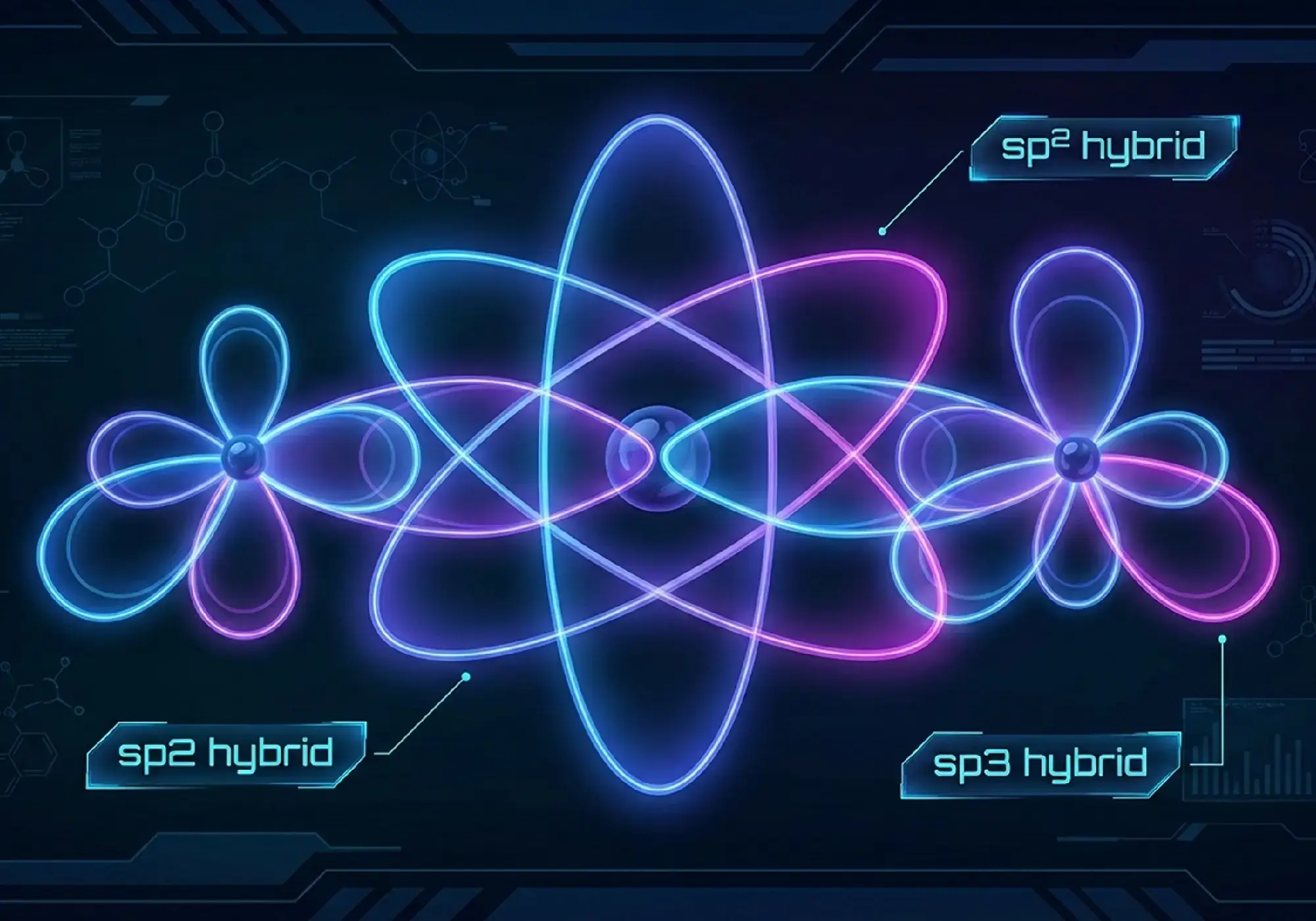
The Secret Life of Organic Chemistry Bonding: Unlocking Hybridization, Shapes & Electron Clouds
Curious about why carbon can form millions of compounds while most of the other elements barely make a few? The secret lies in organic chemistry bonding the invisible framework that builds every molecule around you, from the DNA in our cells to the caffeine in our morning coffee. Understanding atoms is not just about memorizing formulas. It’s about seeing electron clouds, feeling how orbitals overlap, and visualizing why molecules twist, bend, and react. Hybridization and molecular geometry are not just abstract ideas; they explain why diamonds are hard, gasoline burns, and our phone screen responds to our touch. In this deep dive, we will explore sigma and pi bonds, decode hybridization from sp³ to sp, and uncover how electron density maps reveal the real nature of chemical bonding. Whether you are aiming to ace organic chemistry or are simply curious, this guide will change the way you see molecules forever. Covalent Bonds: A Quick Refresher Covalent bonds happen when atoms share electrons to become stable. But here’s the twist textbooks often miss: electrons don’t just sit between atoms like tiny planets. The real magic is orbital overlap, when atomic orbitals merge to form a shared space for electrons. Imagine two soap bubbles touching. The area where they overlap? That’s your bond. The bigger the overlap, the stronger the connection. This shared space packs electron density right between the nuclei, holding them together with electrostatic attraction. Sigma (σ) vs. Pi (π) Bonds There are two fundamental types of covalent bonds, and understanding their difference is crucial for mastering organic chemistry bonding: Sigma (σ) bonds form through head-on orbital overlap. Picture two orbitals meeting face-to-face along the axis connecting the atoms. This creates a cylindrical cloud of electron density directly between the nuclei. Every single bond you see is a sigma bond. Pi (π) bonds form through side-by-side overlap of p orbitals. Imagine two parallel orbitals touching along their sides, creating electron density above and below the bonding axis. Pi bonds always come as additions to sigma bonds in double and triple bonds. Here’s the visual breakdown: The sigma framework acts as the skeleton of organic molecules, while pi clouds add reactivity and rigidity. Why Sigma Bonds Allow Rotation, Pi Don’t This is where it gets fascinating. Sigma bonds allow free rotation because their electron cloud is evenly spread around the bond axis. Twist a single bond all the way around, and the orbital overlap stays the same; nothing snaps. Pi bonds, on the other hand, are stuck. Their side-by-side p orbital overlap would break if the bond rotated, destroying the connection. That’s why double bonds make molecules rigid and give rise to cis-trans isomers. Think of the pi cloud like a molecular handcuff, locking the shape in place. Recognizing how bonds rotate is key to predicting how molecules twist, fold, and react in organic chemistry. Hybridization Theory: From Orbitals to Shapes In the 1930s, Linus Pauling cracked a big mystery: if carbon has two types of atomic orbitals—one s and three p—why do its four bonds in methane all look the same? His answer was hybridization. Before bonding, atomic orbitals combine mathematically to form new, equivalent hybrid orbitals. This isn’t a physical mix; it’s a quantum idea that predicts molecular shapes and bonding patterns more accurately. Valence bond theory uses hybridization to explain molecule shapes, while molecular orbital theory shows the full electronic structure. Both are correct, but hybridization is easier to grasp, especially when studying organic chemistry bonding. sp, sp², sp³ Explained with Shapes & Angles To understand hybridization explained for the organic world, we look at how many “electron groups” (atoms or lone pairs) surround an atom. sp³ Hybridization: One s orbital + three p orbitals = four equivalent sp³ orbitals arranged tetrahedrally. Bond angle: 109.5°. This is your standard carbon in alkanes, with maximum electron repulsion balance according to VSEPR theory. sp² Hybridization: One s orbital + two p orbitals = three sp² orbitals in a trigonal planar arrangement. Bond angle: 120°. One p orbital remains unhybridized and perpendicular to the plane, ready to form pi bonds. This is the carbon in alkenes. sp Hybridization: One s orbital + one p orbital = two sp orbitals in a linear arrangement. Bond angle: 180°. Two p orbitals remain unhybridized for forming two pi bonds. This is the carbon in alkynes. The pattern? More s character means orbitals hold electrons closer to the nucleus, making atoms more electronegative and bonds stronger and shorter. Hybridization Types in Organic Chemistry Hybridization Orbitals Mixed Number of Hybrid Orbitals Molecular Shape Bond Angle Unhybridized p Orbitals Typical Organic Example sp³ 1 s + 3 p 4 sp³ Tetrahedral 109.5° 0 Alkanes (e.g., methane, ethane) sp² 1 s + 2 p 3 sp² Trigonal planar 120° 1 Alkenes (e.g., ethene) sp 1 s + 1 p 2 sp Linear 180° 2 Alkynes (e.g., ethyne) Lone Pairs and Deviations Hybridization isn’t just about bonding orbitals—lone pairs play a role too. They occupy hybrid orbitals and influence molecular shapes by repelling other electrons. Take ammonia (NH₃) as an example. Its nitrogen is sp³ hybridized with one lone pair. Normally, a tetrahedral angle would be 109.5°, but the lone pair pushes harder than bonding pairs. This compresses the H–N–H angle to 107°. Water (H₂O) takes it a step further. Oxygen is sp³ hybridized with two lone pairs. These lone pairs push strongly, squeezing the H–O–H angle to 104.5°. The molecule forms a bent shape, not a perfect tetrahedron, because lone pairs dominate the repulsion forces. This shows that hybridization predicts how orbitals arrange themselves. VSEPR theory fine-tunes the molecular geometry. It does so by accounting for electron-electron repulsion. Electron Clouds & Bonding Patterns in Organic Chemistry Bonding We often draw electrons as dots, but in reality, they exist as a “cloud” or electron density. 1. Electron Density Maps Electron density maps show where electrons actually hang out. Instead of rigid sticks, bonds appear as fuzzy clouds with areas of high and low concentration. When electron density is