
Imagine a ball rolling toward a hill. If it does not have enough energy to reach the top, it rolls back down. Every time. That is how classical physics works. A ball cannot cross a hill unless it has enough energy to get over it.
Now make that ball as tiny as an electron. Send it toward a barrier it lacks enough energy to cross. Something strange happens. Sometimes, the electron appears on the other side.
It does not go around the barrier. It does not climb over it. Somehow, it passes through a barrier that classical physics says should stop it.
This strange effect is called quantum tunneling. It is one of the most fascinating and well-tested phenomena in modern physics. It may sound like magic, but it is real. Scientists can measure it, predict it, and use it in real-world technology.
In fact, quantum tunneling quietly plays a role in many things around us, from the energy produced inside the Sun to the flash drive in your pocket. But how can a particle cross a barrier when it does not have enough energy? To understand that, we first need to see why it should be impossible in classical physics.
What Is Quantum Tunneling?
Quantum tunneling is a strange quantum effect. It allows a particle to pass through an energy barrier even when it does not have enough energy to cross it by classical rules.
At first, this sounds impossible. Yet, quantum mechanics allows it. In fact, quantum tunneling is a clear example of the differences between the quantum world and the world we experience every day.
Why Classical Physics Says It Should Not Happen
In classical physics, energy acts like a strict gatekeeper.
A particle needs enough kinetic energy to overcome a barrier. If the barrier has more energy than the particle, the particle cannot cross it. The barrier simply stops or reflects the particle.
This rule works perfectly for everyday objects. A car cannot climb a hill if it lacks enough energy. A ball cannot roll over a wall that is too high. A billiard ball also bounces back when it hits a barrier it cannot overcome. So, according to classical physics, there is no way through.
What Quantum Mechanics Changes
Quantum mechanics gives us a very different picture. It does not describe tiny particles as simple billiard balls with fixed paths. Instead, it describes them using a wavefunction.
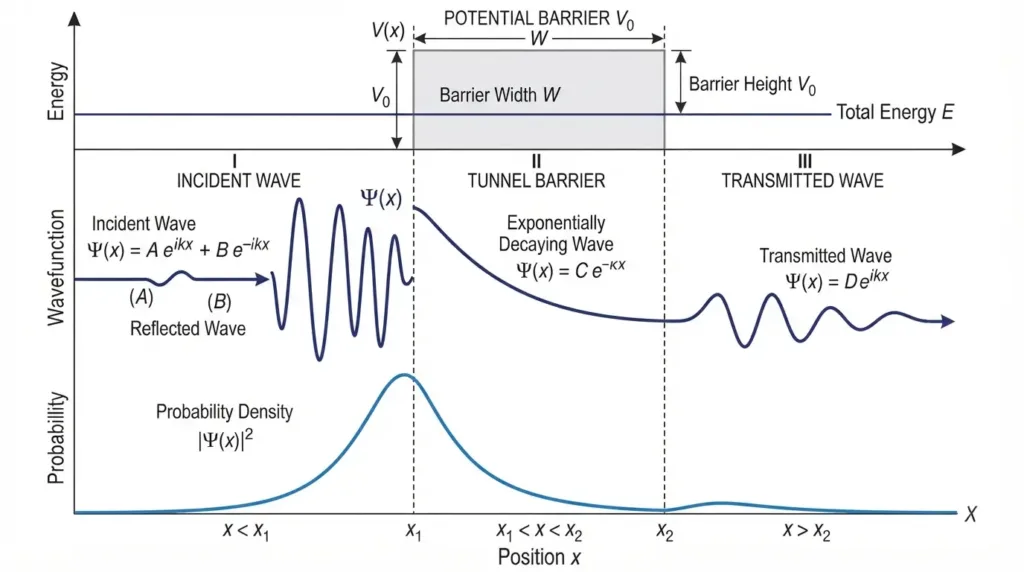
The wavefunction spreads through space. When a particle reaches an energy barrier, its wavefunction does not suddenly stop at the barrier. Instead, part of it can extend into and even beyond the barrier.
And this leads to the key idea. Wherever the wavefunction has a non-zero value, there is a chance of detecting the particle.
The particle might not have enough classical energy to cross the barrier. Despite this, there can still be a small probability of finding it on the other side.
Why “Tunneling” Is Only an Analogy
The word tunneling can create the wrong picture. It may sound as if a particle digs through a solid barrier like a mole. But that is not what happens. The particle does not drill a hole. It does not melt the barrier. It does not push the material aside.
Instead, its wavefunction extends through the barrier and can reach the other side. If that part of the wavefunction is large enough, we have a chance of detecting the particle there. That is why scientists call it quantum tunneling. The name describes the effect, but the particle does not literally tunnel through a wall.
How Does Quantum Tunneling Work?
This is where the real mechanics of quantum tunneling come in. It explains how something that seems “weird” can actually become predictable.
Particles Behave Like Quantum Waves
Every particle also has a wave-like nature. The Schrödinger equation describes this behavior.
Instead of giving a particle one fixed position, quantum mechanics describes it with a wavefunction. The wavefunction tells us where the particle might be found.
More precisely, the square of the wavefunction’s amplitude gives the probability of finding the particle at a particular location.
What Happens When the Wavefunction Meets a Barrier?
Now imagine the particle moving toward a potential barrier. The barrier has more energy than the particle. According to classical physics, the particle should stop at the barrier. It does not have enough energy to cross it.
Quantum mechanics, however, gives us a different result. When the wavefunction reaches the barrier, part of it reflects. But another part enters the barrier itself.
That is the first key to understanding quantum tunneling.
Why Doesn’t the Wavefunction Immediately Become Zero?
Inside the barrier, the wavefunction behaves differently. It does not keep oscillating as it does in open space. Instead, it decays exponentially. In simple terms, it gets smaller and smaller as it moves through the barrier. However, it does not instantly become zero. As long as the barrier has a limited width, a small part of the wavefunction can survive all the way through it.
Why Is There Still a Probability Beyond the Barrier?
This is where tunneling happens. The wavefunction does not completely disappear before reaching the other side. So, when the barrier ends, a small part of the wavefunction can emerge beyond it. That creates a nonzero probability of finding the particle on the other side.
The particle didn’t have enough energy to cross the barrier according to classical physics. Yet quantum mechanics allows it to appear beyond the barrier. That is the basic mechanism behind quantum tunneling.
What Determines the Probability of Quantum Tunneling?
Quantum tunneling does not happen with the same chance every time. Several factors decide how likely a particle is to tunnel through a barrier. Four factors matter most.
1. Barrier Width
The width of the barrier plays a major role. A wider barrier gives the wavefunction more space to decay. As a result, the tunneling probability falls exponentially as the barrier gets wider. Even a small increase in thickness can make tunneling extremely unlikely.
2. Barrier Height
The height of the barrier also matters. A taller barrier creates a larger energy gap between the particle and the barrier. The wavefunction then decays faster inside the barrier. Therefore, the higher the barrier, the lower the chance of tunneling.
3. Particle Mass
Mass makes tunneling much harder. Heavier particles have shorter de Broglie wavelengths. Their wavefunctions also decay more quickly inside a barrier. This is why electrons can tunnel relatively easily, while protons tunnel much less often. For much heavier objects, tunneling becomes almost impossible on everyday scales.
4. Particle Energy
The particle’s energy matters, too. When a particle’s energy gets closer to the barrier’s height, its wavefunction decays more slowly inside the barrier. The tunneling probability then increases.
In contrast, a particle with energy far below the barrier has a much smaller chance of getting through. So, the closer the particle’s energy is to the barrier height, the more likely tunneling becomes.
| Factor | Effect on Tunneling Probability |
|---|---|
| Barrier width | Wider barrier → lower probability (exponential drop) |
| Barrier height | Taller barrier → lower probability |
| Particle mass | Heavier particle → dramatically lower probability |
| Particle energy | Energy closer to barrier height → higher probability |
Mass is what makes tunneling so important for electrons but almost impossible for baseballs. As an object’s mass increases, its chance of tunneling drops exponentially. This key idea also leads us to the next question.
Can a Particle Tunnel Through Any Barrier?
Not every barrier allows tunneling. Also, not every particle behaves the same way when it hits a barrier.
Finite Potential Barriers
Most barriers in the real world have a finite height and width. Think of a thin layer of an insulator, the electrical repulsion around an atomic nucleus, or the energy barrier in a chemical reaction.
Because these barriers are finite, a particle’s wavefunction can extend into them. In some cases, it can even appear on the other side. That is where quantum tunneling becomes possible.
Why Infinite Barriers Are Different
An infinitely tall or infinitely wide barrier is a different story. Such a barrier gives the wavefunction no way to pass through. Its amplitude falls to zero before it can reach the other side. As a result, the tunneling probability becomes exactly zero. Of course, an infinite barrier is an ideal mathematical idea. Real barriers in our universe have finite sizes and energies.
Why Macroscopic Objects Do Not Normally Tunnel Through Walls
Now comes the question everyone asks: Could a person tunnel through a wall?
In principle, quantum mechanics does not make the probability exactly zero. But in practice, it is unbelievably tiny.
A person’s mass is enormous compared with that of a quantum particle. As a result, their quantum wavelength becomes incredibly small. This makes the probability of tunneling through a wall so tiny that we could never realistically expect it to happen.
In fact, the expected waiting time would be vastly longer than the age of the universe. So, while quantum mechanics leaves the door open in theory, using an actual door is still a much faster option.
Quantum Tunneling in Radioactive Decay
Quantum tunneling is not just a strange idea from the lab. It also plays a key role in radioactive decay. In fact, it helps explain how some atomic nuclei break apart.
How Alpha Particles Escape Atomic Nuclei
Inside a heavy nucleus, such as uranium, an alpha particle contains two protons and two neutrons. The strong nuclear force holds it inside the nucleus. At the same time, electromagnetic repulsion pushes it outward.
However, the alpha particle does not have enough energy to cross the potential barrier under classical physics. So, according to classical rules, it should remain trapped. Quantum mechanics tells a different story. The particle can pass through the barrier by quantum tunneling. As a result, it can escape the nucleus even without having enough energy to cross the barrier normally.
Why Tunneling Controls the Half-Life
Quantum tunneling also determines how long a radioactive nucleus can survive. The easier it is for an alpha particle to tunnel out, the faster the nucleus decays. Even a small increase in the particle’s energy can greatly increase its tunneling probability. Likewise, a slightly thinner effective barrier can make tunneling much more likely. Because of this, different isotopes can have vastly different half-lives. Some decay quickly, while others remain stable for extremely long periods.
Gamow’s Explanation of Alpha Decay
In 1928, physicist George Gamow used quantum tunneling to explain alpha decay mathematically. He showed how the energy released during nuclear decay relates to the nucleus’s half-life. This was a major success for quantum mechanics. It showed that quantum theory could explain real nuclear processes. Even today, Gamow’s explanation remains a classic example of quantum tunneling in physics.
How Quantum Tunneling Powers the Sun
Without quantum tunneling, the Sun as we know it would not shine.
Why Protons Cannot Simply Overcome Their Repulsion
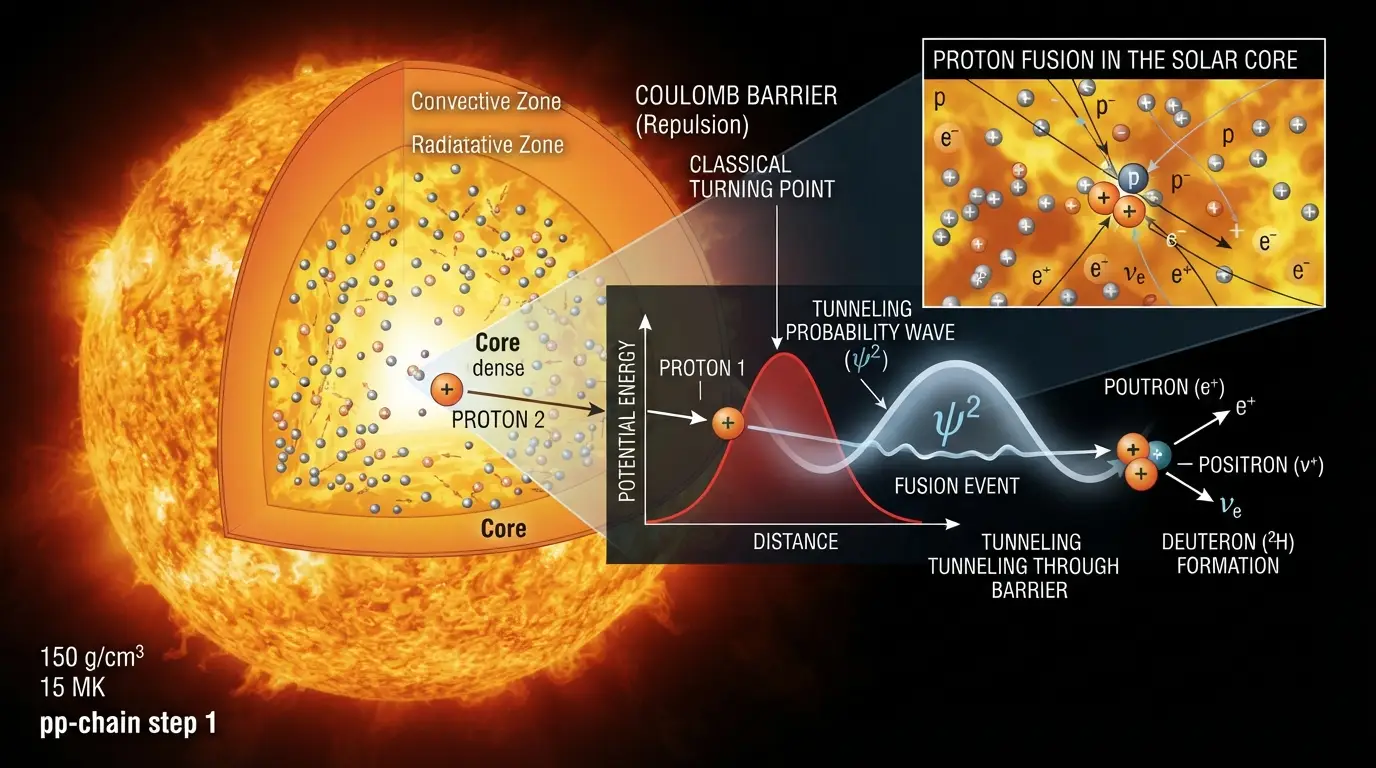
Nuclear fusion needs protons to come close enough for the strong nuclear force to hold them together. However, protons have positive electric charges. As a result, they strongly repel each other when they get close. The Sun’s core reaches about 15 million°C. That sounds incredibly hot, but it still does not give most protons enough energy to overcome this electric repulsion through classical physics alone.
How Tunneling Makes Nuclear Fusion Possible
This is where quantum tunneling changes everything.
Quantum mechanics gives some protons a chance to pass through the electromagnetic barrier even when they do not have enough energy to cross it normally. Only a small fraction of protons can tunnel during any given encounter. Yet the Sun contains an enormous number of protons. Therefore, even a tiny tunneling probability leads to countless fusion reactions every second. In this way, quantum tunneling allows the Sun to keep producing energy.
Why This Matters for Stellar Energy
Without quantum tunneling, stars would need much higher core temperatures to start nuclear fusion. The Sun could not reach those temperatures. So, tunneling plays a crucial role in stellar life. It allows stars to fuse hydrogen slowly and steadily. As a result, stars like the Sun can shine for billions of years instead of failing to ignite at all.
Quantum Tunneling in Modern Technology
Quantum tunneling is not limited to stars and atomic nuclei. In fact, it also works inside many technologies you use every day.
Scanning Tunneling Microscopes
A scanning tunneling microscope (STM) uses an extremely sharp, conductive tip. The tip sits just a fraction of a nanometer above a surface. Electrons can tunnel through this tiny gap. More importantly, the tunneling current changes dramatically with even a tiny change in distance. Scientists use this effect to map surfaces at the atomic level. As a result, an STM can reveal individual atoms with astonishing precision.
Tunnel Diodes
Tunnel diodes, also known as Esaki diodes, use heavily doped semiconductor materials. These materials create an extremely thin barrier that electrons can cross through quantum tunneling. This process creates a unique effect called negative resistance. In this region, the current actually decreases as the voltage increases. Because of this unusual behavior, tunnel diodes can work in fast switching systems and electronic oscillator circuits.
Flash Memory and Quantum Tunneling
Quantum tunneling also plays a key role in flash memory. This is the technology used in USB drives, memory cards, and solid-state storage. Flash memory stores and erases data by moving electrons through a very thin insulating layer. Quantum tunneling makes this movement possible.
So, whenever your phone saves a photo or your computer stores a file on an SSD, quantum tunneling is quietly helping make it happen.
Josephson Junctions and Superconducting Circuits
A Josephson junction consists of two superconductors separated by an extremely thin insulating layer. Under the right conditions, pairs of electrons can tunnel through this barrier. These junctions have several important applications. For example, they help scientists build highly precise measurement devices. They also form a key part of superconducting quantum bits, or qubits. Because of this, Josephson junctions play an important role in modern quantum computing.
| Technology | Everyday Use Case | How Quantum Tunneling is Used |
|---|---|---|
| Scanning Tunneling Microscope (STM) | Atomic Imaging | Measures the tunneling current between a sharp metallic tip and a conductive surface to map topography at the atomic level. |
| Tunnel Diodes | Fast Switching | Utilizes the ultra-rapid speed of quantum tunneling across thin junctions to enable high-frequency operation and microwave switching. |
| Flash Memory (EEPROM) | Data Storage | Employs Fowler-Nordheim tunneling to inject and trap electrons onto a floating gate, allowing non-volatile data retention. |
| Josephson Junctions | Quantum Computing | Leverages superconducting Cooper pairs tunneling through a thin insulating barrier to act as the primary building block (qubits) for quantum computers. |
What the 2025 Nobel Prize Revealed About Quantum Behavior
The 2025 Nobel Prize in Physics went to John Clarke, Michel Devoret, and John Martinis for showing that quantum tunneling can happen on a much larger scale. They used a superconducting circuit about a centimeter wide, built around a Josephson junction. Their experiment showed something remarkable. A system made of billions of particles could tunnel between two different electrical states as if it were one quantum particle.
They also found that the system’s energy existed only at specific, discrete levels. This provided direct evidence that quantum tunneling is not limited to the tiny subatomic world. When scientists isolate a system carefully enough, quantum effects can appear on a much larger scale. The discovery also helped lay the foundation for modern superconducting quantum computers.
What Quantum Tunneling Tells Us About Reality
Quantum tunneling does more than power useful technologies. It also changes how we understand matter and reality at the smallest scales.
Quantum Mechanics Does Not Follow Classical Intuition
Tunneling clearly shows that the universe does not work like the everyday world we know. A ball cannot normally pass through a solid wall. Yet, a quantum particle can sometimes cross an energy barrier that classical physics says it should not cross. At the quantum scale, barriers are not absolute. Instead, they involve probability.
Probability Is Fundamental at the Quantum Scale
Quantum tunneling is not simply a gap in our knowledge. Better measurements will not remove its uncertainty. Instead, probability is a basic part of quantum mechanics.
We cannot always know exactly where a particle will be. We can only predict the probability of finding it in a certain place. Tunneling follows this same rule.
Why Tunneling Challenges Our Everyday Picture of Matter
We usually think of matter as solid. We imagine objects with clear edges and firm boundaries. Quantum tunneling challenges this simple picture. At the smallest scales, even a “solid” barrier does not create an absolute boundary. Instead, it represents an extremely high probability that a particle will stay on one side.
In other words, quantum mechanics replaces certainty with probability. A particle usually stays where we expect it to, but nature does not make that outcome a guarantee.
Frequently Asked Questions About Quantum Tunneling
No. Quantum tunneling follows the laws of quantum mechanics. It also does not break the law of energy conservation. The effect seems strange because it goes against our everyday, classical intuition. However, it does not violate the laws of physics.
In principle, the probability is not exactly zero. However, the chance is unbelievably small for something as large and massive as a human. As a result, we would never expect to observe a person quantum tunneling through a wall.
No confirmed experiment has shown that quantum tunneling can send information faster than light. Scientists still study how to define and measure the “speed” of tunneling. However, this research does not provide evidence for faster-than-light communication.
Quantum tunneling plays an important role in many technologies and natural processes. It is used in scanning tunneling microscopes, tunnel diodes, flash memory, and Josephson junctions. It also plays a role in superconducting qubits, radioactive alpha decay, and nuclear fusion inside stars.
Yes, tunneling effects can occur at the molecular scale. For example, scientists study quantum tunneling in some enzyme reactions and proton-transfer processes inside biological molecules. However, these effects occur at extremely small scales. They are not something we notice in everyday human biology.
Conclusion: When the Impossible Becomes Possible
Classical physics sees a barrier as a wall. A particle either crosses it or it does not. Quantum mechanics sees something very different. It describes the particle as a probability wave. This wave can fade as it reaches a barrier, but it does not always disappear. There is still a small chance of finding the particle on the other side.
This change from certainty to probability is what makes quantum tunneling possible. It explains how stars can shine even when their cores seem too cool for fusion. It also helps explain why radioactive nuclei decay over predictable timescales. Moreover, many highly precise instruments and modern memory chips depend on this strange quantum behavior.
So, the next time you use solar-powered technology or save a file on a flash drive, remember something fascinating. Somewhere inside that technology, particles may have crossed a barrier. Classical physics asserts that they should not be able to cross such a barrier.
Recommended Resources for Curious Minds
This section may include Amazon affiliate links. As an Amazon Associate, this site may earn from qualifying purchases, at no extra cost to you. Recommendations are chosen for educational value, not sponsorship.
1. Quantum Mechanics: The Theoretical Minimum — Leonard Susskind and Art Friedman
This book gives a clear, equation-based introduction to quantum mechanics. It explains wavefunctions and barrier problems step by step. It’s a great choice if you want to understand the real mathematics behind quantum tunneling instead of relying only on simple analogies. Check it out here!
2. Six Easy Pieces — Richard Feynman
Feynman explains the basic ideas of physics in a simple and approachable way. The book helps build a strong understanding of the difference between classical and quantum physics. That foundation makes the strange behavior of quantum tunneling much easier to understand. Check it out here!
3. In Search of Schrödinger’s Cat — John Gribbin
This book tells the story of quantum mechanics through an engaging historical narrative. It explores ideas such as quantum tunneling, wave-particle duality, and probability. As a result, it helps put these concepts into their historical context. Check it out here!
4. 4M Kidzlabs Anti-Gravity Magnetic Levitation Science Kit
This educational science kit contains all the materials necessary to perform seven fun science projects, from levitating a screw to building a maglev and much more. Check it out here!