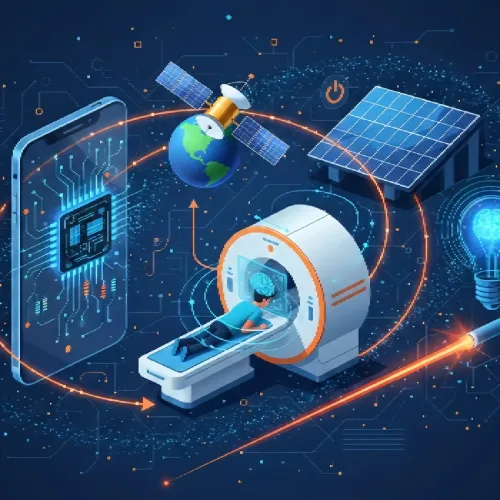
Every time you check your phone’s location, step into a hospital for a scan, or switch on an LED light, you’re seeing applications of modern physics. It may feel normal. However, behind these simple actions lies one of the greatest scientific revolutions in history.
Modern physics was born in the early 20th century. At first, it sounded abstract and even strange. Scientists talked about quantum mechanics and relativity—ideas that bent the rules of classical physics. Yet over time, those bold theories turned into the backbone of today’s technology. Now they power the devices we use every single day.
So, what exactly is modern physics? In simple terms, it studies matter, energy, space, and time at extreme scales. When Newton’s laws stop working, modern physics steps in. It explains the behavior of tiny particles through quantum mechanics. It also explains fast-moving objects and massive bodies through relativity. In addition, it deepens our understanding of electromagnetic radiation. These concepts are not just classroom topics. Instead, they drive GPS systems, medical imaging tools, powerful computers, and countless real-world technologies.
That’s why understanding these everyday applications truly matters. Technology is evolving fast. Quantum computers are emerging. Advanced sensors are becoming smarter. AI-based medical tools are growing more accurate. As a result, knowing the physics behind these innovations helps us see the bigger picture. It allows us to appreciate not only what exists today but also what is coming next.
From the lasers inside a Blu-ray player to atomic clocks that keep global communication in sync, modern physics is everywhere. It is not locked inside research labs. Rather, it lives in your pocket, sits on your wrist, and surrounds you at every moment.
Core Principles of Modern Physics Explained Simply for Beginners
Before diving into specific technologies, let’s understand the three fundamental pillars of modern physics that make today’s innovations possible.
1. Quantum Mechanics Basics
Quantum mechanics, explained in simple terms, uncovers a surprising truth: at the atomic and subatomic level, the world doesn’t follow the rules we see around us every day.
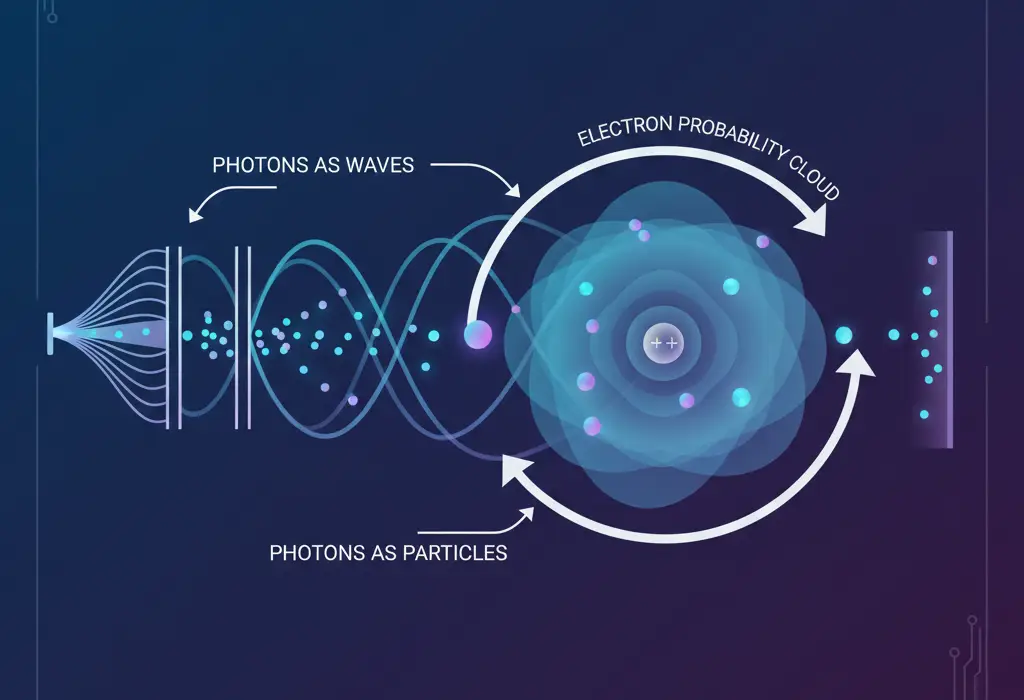
Instead of moving like tiny solid balls, particles act in strange and unexpected ways. They don’t have fixed positions or clear speeds. Instead, they exist as probabilities — possibilities — until we actually measure them.
For example, electrons don’t travel around the nucleus in neat circular paths like planets around the Sun. Rather, they exist in “clouds” of probability. These clouds show where an electron is most likely to be found when we observe it.
Key quantum concepts that enable modern technology include:
- Wave-particle duality: Light and matter can behave as both waves and particles, depending on how we observe them
- Quantization: Energy exists in discrete packets called “quanta” rather than continuous amounts
- Quantum tunneling: Particles can pass through energy barriers that classical physics says should be impossible
- Spin and superposition: Particles possess intrinsic properties that allow them to exist in multiple states simultaneously
These principles aren’t philosophical abstractions. They’re the reason semiconductors work, lasers emit coherent light, and MRI machines can image soft tissue inside your body.
2. Relativity Fundamentals
Einstein completely changed how we see the universe. His theories of relativity reshaped our understanding of space, time, and gravity forever.
First came special relativity in 1905. It showed something mind-blowing: space and time are not separate. They are connected. Even more surprising, time does not move the same for everyone. When something travels very fast, its clock slows down. This effect is called time dilation. So in simple terms, the faster you move, the slower time passes for you.
Then, in 1915, Einstein introduced general relativity. This theory went deeper. It explained gravity in a totally new way. Instead of thinking of gravity as a force pulling objects together, Einstein described it as a bending of spacetime. Massive objects like planets and stars curve the fabric of spacetime around them. As a result, other objects move along those curves. That curved motion is what we experience as gravity.
Now here’s the exciting part. Relativity is not just theory. It powers modern technology.
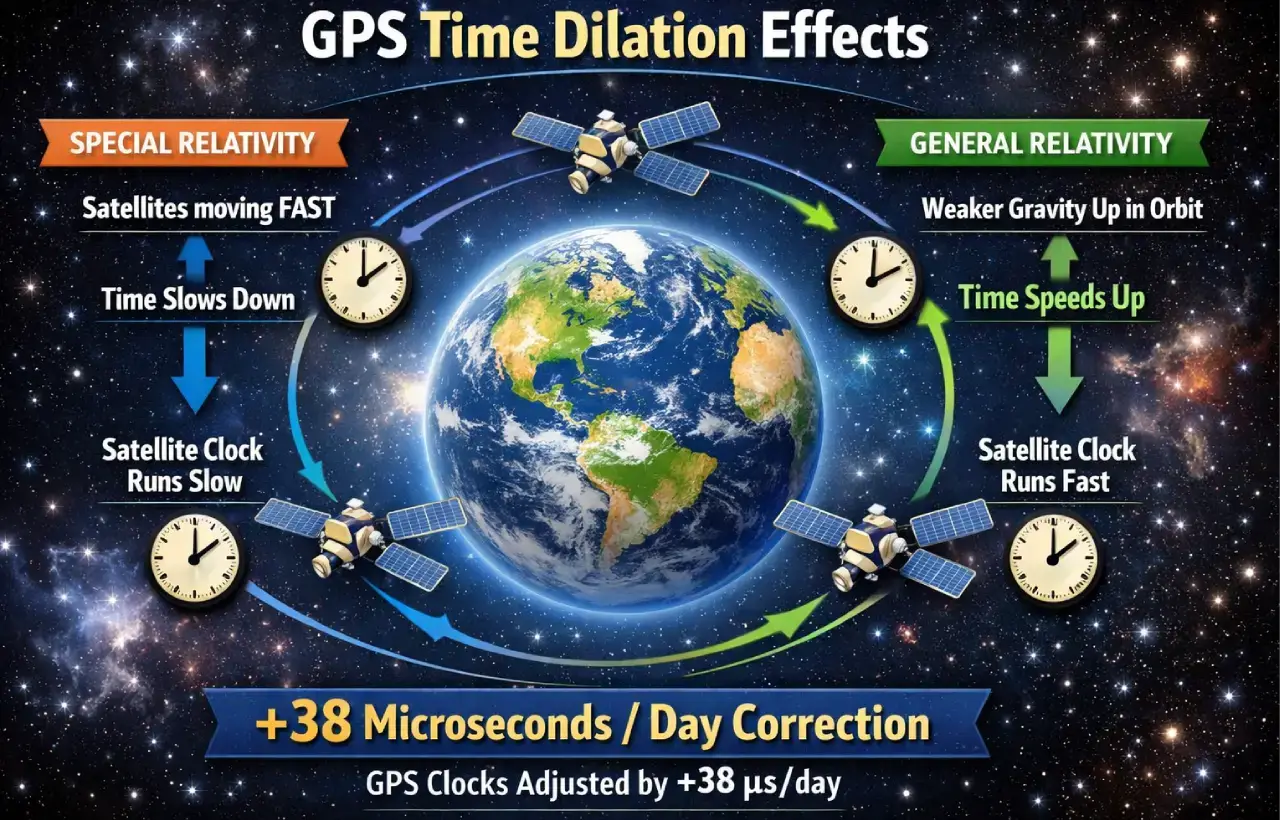
Take GPS systems, for example. Satellites orbit Earth at very high speeds. At the same time, they are farther from Earth’s gravity compared to us on the ground. Because of their speed, special relativity makes their clocks run slightly slower. However, because they experience weaker gravity, general relativity makes their clocks run slightly faster. Both effects happen together.
If scientists did not correct these tiny time differences, GPS would drift off by several kilometers each day. Navigation would fail. Maps would be unreliable. In short, modern location services would not work.
So next time you open Google Maps, remember: you are using Einstein’s relativity in real time.
3. Electromagnetism and Wave-Particle Ideas
The electromagnetic (EM) spectrum uses span from radio waves to gamma rays, all traveling at the speed of light but with vastly different energies and wavelengths. Modern physics revealed that electromagnetic radiation behaves as both continuous waves and discrete particles called photons.
This dual nature enables:
- Targeted energy delivery: Different wavelengths interact with matter in specific ways, allowing medical lasers to target tissues precisely
- Information encoding: Radio waves, microwaves, and infrared carry data for wireless communication
- Quantum interactions: Photons with specific energies can excite electrons in solar panels or semiconductor devices
Understanding how photons interact with electrons in materials opened the door to semiconductor physics, photonics and optics, and the entire digital revolution.
Everyday Applications of Modern Physics in Daily Life
Modern physics isn’t just theory sitting in textbooks. It drives the technology you use every single day. So instead of thinking of it as abstract science, think of it as the hidden engine behind your daily life. From the moment you wake up, it’s already at work.
Now, let’s break it down and explore the real-world physics innovations behind the devices you probably used today.
Lasers: How Stimulated Emission Enables Technology
The word “laser” stands for Light Amplification by Stimulated Emission of Radiation, and this process is pure quantum mechanics in action. In a laser, atoms are excited to higher energy states, then stimulated to release photons in a coordinated way, producing an intense, coherent beam of light.
Laser everyday uses include:
- Optical drives: Blu-ray and DVD players use blue or red laser light to read microscopic pits on disc surfaces
- Barcode scanners: Supermarket checkout systems rely on laser reflection patterns
- Laser surgery: Ophthalmologists use lasers to reshape corneas (LASIK) or treat retinal damage with sub-millimeter precision
- Fiber optic communication: Internet backbone infrastructure uses laser pulses traveling through glass fibers at light speed
- Manufacturing: Industrial lasers cut metal, weld components, and 3D-print objects with extreme accuracy
The key advantage? Lasers produce monochromatic (single-color) light that can be focused to incredibly small spots, delivering precise energy exactly where needed. This quantum phenomenon transformed medicine, manufacturing, and communication.
GPS: Relativity and Timekeeping Precision
Your smartphone can pinpoint your location within meters anywhere on Earth, thanks to a constellation of 24+ satellites orbiting 20,000 kilometers above. But this everyday miracle depends critically on understanding GPS time dilation.
Here’s how it works: Each GPS satellite broadcasts precise time signals using atomic clocks. Your receiver compares these signals from multiple satellites to calculate your position through triangulation. Since radio signals travel at light speed, timing accuracy of just 1 nanosecond (one billionth of a second) determines position accuracy of about 30 centimeters.
The problem? Two relativistic effects constantly alter satellite clock rates:
- Special relativity effect: Satellites move at about 14,000 km/h, causing their clocks to run about 7 microseconds per day slower than ground clocks
- General relativity effect: Satellites experience weaker gravity, causing their clocks to run about 45 microseconds per day faster than ground clocks
The net effect is about 38 microseconds per day faster. Without correcting for these relativity in technology effects, GPS would accumulate positioning errors of 10+ kilometers daily, rendering navigation useless. Every GPS device you’ve ever used applies Einstein’s equations continuously in real-time.
MRI & Medical Imaging: Spin Physics Saving Lives
Magnetic Resonance Imaging shows one of medicine’s greatest diagnostic tools, providing detailed images of soft tissues without harmful radiation. The technology works by exploiting the quantum property called “spin.”
Hydrogen atoms (abundant in water and fat throughout your body) behave like tiny magnets. In an MRI machine’s powerful magnetic field (typically 1.5 to 3 Tesla—about 30,000 times Earth’s magnetic field), these atomic magnets align. Radio wave pulses then flip them out of alignment. As they relax back, they emit radio signals at characteristic frequencies depending on their chemical environment.
Different tissues contain different concentrations and types of hydrogen bonds, producing distinct signals. Advanced imaging protocols can:
- Distinguish tumors from healthy tissue
- Detect torn ligaments and damaged cartilage
- Map blood flow and brain activity in real-time
- Image the beating heart without invasive procedures
MRI technology continues advancing with higher field strengths, faster scanning, and functional imaging that reveals not just anatomy but physiological processes. This quantum sensing technology has revolutionized neuroscience, oncology, and orthopedics.
Smartphones & Microchips: Semiconductors and Electron Behavior
The smartphone in your pocket contains billions of transistors etched onto silicon chips smaller than your fingernail. These transistors are the fundamental switches that enable all digital computation, and they work because of semiconductor physics rooted in quantum mechanics.
Silicon sits in the middle of the periodic table—it’s neither a good conductor like copper nor an insulator like glass. By carefully adding impurities (a process called “doping”), engineers can precisely control silicon’s electrical properties. Quantum mechanics explains how electrons behave in these doped semiconductors, enabling:
- Transistors: Quantum tunneling and band gap engineering allow tiny voltages to control electron flow, creating the “on/off” switches that process information
- Memory chips: Electrons trapped in carefully designed quantum wells store your photos, apps, and data
- Image sensors: Photons striking semiconductor pixels liberate electrons through the photoelectric effect, capturing images
- Processors: Modern CPUs pack over 10 billion transistors into chips with features just 5 nanometers across—a scale where quantum effects dominate
Without understanding quantum mechanics explained through semiconductor behavior, we’d still be using room-sized vacuum tube computers. The entire digital revolution stems from manipulating electron behavior at quantum scales.
Solar Panels & LEDs: Quantum in Energy and Light
Two quantum technologies are transforming how we generate and use energy: photovoltaic solar panels and light-emitting diodes (LEDs).
Solar panels convert sunlight directly into electricity through the photovoltaic effect. When photons strike semiconductor materials like silicon, they can transfer their energy to electrons, promoting them across the material’s “band gap” and generating electric current. The quantum nature of this process means only photons with sufficient energy (corresponding to specific wavelengths) can liberate electrons—which is why solar panel efficiency depends on matching materials to the solar spectrum.
Modern solar cells achieve 20-25% efficiency in commercial applications, with research cells exceeding 40% using multiple layers tuned to different wavelengths. As manufacturing costs have dropped dramatically, solar power has become the cheapest form of new electricity generation in many regions.
LEDs work in reverse: electrical current excites electrons across a semiconductor band gap, and when they drop back down, they release energy as photons. Unlike incandescent bulbs (which waste 90% of energy as heat), LEDs convert electricity to light with 80-90% efficiency.
The quantum engineering of LED materials determines their color—different semiconductor compositions produce different photon energies and thus different wavelengths. This precision enables:
- Energy-efficient lighting that lasts 50,000+ hours
- Full-color displays on phones, TVs, and billboards
- Grow lights optimized for plant photosynthesis
- Medical phototherapy devices
The global shift from incandescent to LED lighting saves hundreds of billions of kilowatt-hours annually—a testament to how quantum physics directly impacts sustainability.
Advanced Sensors and Measurement Technologies: Applications and Innovations
Beyond consumer devices, modern physics enables the ultra-precise sensors that make advanced technology possible.
Atomic & Optical Clocks in Navigation & Data Systems
The most accurate timekeepers ever built rely on atomic clocks applications in atomic and optical physics. These devices measure time by counting the oscillations of electromagnetic radiation emitted by atoms transitioning between energy states.
Cesium atomic clocks, the international standard since 1967, are accurate to about 1 second in 100 million years. Newer optical atomic clocks—which use laser light instead of microwaves to probe atomic transitions—achieve accuracy better than 1 second in 15 billion years (longer than the universe’s age).
Why does extreme timekeeping matter?
- GPS and navigation: As discussed earlier, every GPS satellite carries multiple atomic clocks
- Telecommunications: Cell towers and internet infrastructure use atomic clock synchronization to coordinate data transmission
- Scientific research: Telescope arrays, gravitational wave detectors, and particle accelerators require nanosecond timing precision
- Financial trading: Stock markets timestamp transactions to microsecond accuracy using atomic clock networks
- Geodesy: Comparing atomic clocks at different elevations measures Earth’s gravitational field and tectonic movement
Atomic clocks applications extend far beyond telling time—they’re fundamental infrastructure for modern technological civilization.
Advanced Imaging Sensors (CCD, CMOS)
Digital cameras, medical imaging devices, telescopes, and scientific instruments rely on electronic image sensors that convert photons into electrical signals. The two dominant technologies—CCD (Charge-Coupled Device) and CMOS (Complementary Metal-Oxide-Semiconductor)—both exploit the photoelectric effect, where incoming photons liberate electrons in semiconductor materials.
CCD sensors transfer accumulated charge from pixel to pixel in a coordinated sequence, reading out the entire image systematically. They offer excellent image quality and sensitivity, making them ideal for professional astronomy and scientific imaging.
CMOS sensors allow each pixel to be read individually and include amplification circuitry at each photosite. This enables faster readout, lower power consumption, and integration of additional processing directly on the chip. Most smartphone cameras, webcams, and modern DSLRs use CMOS technology.
Recent innovations include:
- Quantum dot sensors: Nanocrystals that absorb specific wavelengths with exceptional efficiency
- Back-illuminated sensors: Flipped architecture that captures more light by removing obstructing circuitry
- Computational photography: Combining sensor data with advanced algorithms to achieve results impossible with optics alone
These quantum sensors enable everything from smartphone photography to Mars rovers capturing landscapes billions of kilometers away.
Quantum Sensors & Navigation
An emerging frontier in measurement technology leverages quantum superposition and entanglement to achieve sensitivities impossible with classical devices. Quantum sensors can detect:
- Magnetic fields: Quantum magnetometers using nitrogen-vacancy centers in diamond achieve sensitivities enabling non-invasive brain imaging and underground mineral detection
- Gravitational variations: Cold atom interferometers measure tiny gravity fluctuations for geological surveying and navigation
- Rotation: Quantum gyroscopes provide navigation-grade accuracy without GPS, crucial for submarines and aircraft
- Electric fields: Rydberg atom sensors detect electromagnetic signals with unprecedented sensitivity
Quantum navigation systems are particularly revolutionary. By measuring Earth’s magnetic and gravitational fields with quantum precision, vehicles could navigate accurately even when GPS is unavailable or jammed. The UK, US, and China are investing heavily in quantum navigation for both military and commercial applications.
Future Trends & Applications of Modern Physics: What’s Next in Technology
Modern physics innovations continue accelerating. Here’s what emerging technologies promise for the coming decades.
Quantum Navigation Without GPS
GPS dependence creates vulnerability—the weak satellite signals are easily jammed or spoofed, threatening military operations, aviation, and critical infrastructure. Quantum navigation offers an alternative using ultra-precise accelerometers and gyroscopes based on cold atom interferometry.
These systems measure acceleration and rotation by observing how matter waves interfere when atoms are manipulated with lasers. Because measurement accuracy depends on fundamental physical constants rather than external signals, quantum inertial navigation systems (Q-INS) can:
- Operate anywhere without external signals (underground, underwater, in space)
- Resist jamming and spoofing
- Provide positioning accuracy comparable to GPS over extended periods
- Integrate with existing systems for enhanced resilience
The UK government invested £70 million in quantum navigation development, while DARPA’s APTS program achieved navigation accuracy of 1 meter after an hour without GPS. Commercial systems could reach vehicles, ships, and aircraft within the next decade.
Ultra-Precise Medical Diagnostics
Quantum sensors are revolutionizing medical imaging and diagnostics beyond traditional MRI and CT scans:
Magnetoencephalography (MEG): Quantum magnetometers can detect the brain’s magnetic fields without the massive, expensive equipment traditional MEG requires. This enables portable brain imaging for stroke detection, epilepsy monitoring, and cognitive research.
Molecular imaging: Quantum dots—semiconductor nanocrystals—can be engineered to target specific cells and emit precise wavelengths when illuminated. This allows tracking disease progression, drug distribution, and cellular processes in living organisms with unprecedented detail.
Early cancer detection: Quantum sensors can identify cancer biomarkers at extremely low concentrations, potentially detecting tumors years earlier than current methods. Research groups are developing breathalyzer-style devices that use quantum sensors to detect volatile organic compounds associated with specific cancers.
Personalized medicine: Quantum simulations of drug-protein interactions could predict individual patient responses, optimizing treatment before trials begin.
These technologies promise shifting medicine from reactive treatment to proactive prediction and prevention, potentially saving millions of lives and reducing healthcare costs.
Physics in AI & Computation
Artificial intelligence and physics are increasingly intertwined in both directions.
Physics enhancing AI: Neuromorphic computing chips mimic brain structure using physics principles. These processors:
- Consume orders of magnitude less power than conventional processors
- Perform pattern recognition and sensory processing with biological efficiency
- Enable AI capabilities in edge devices without cloud connectivity
Photonic neural networks use light instead of electricity for computations, dramatically accelerating machine learning while reducing energy consumption. IBM and startups are developing optical AI accelerators that could train models 100x faster than current GPUs.
AI enhancing physics: Machine learning now accelerates scientific discovery:
- Materials discovery: AI predicts promising new materials from millions of candidates, guiding experiments
- Particle physics: Neural networks identify patterns in detector data from billions of collisions
- Climate modeling: AI improves simulation resolution and speed
- Fusion energy: Machine learning optimizes plasma containment in experimental reactors
The synergy between physics principles and AI algorithms is creating feedback loops that accelerate both fields simultaneously.
Conclusion
From the smartphone in your hand to the GPS guiding you home, from the MRI that diagnosed your injury to the LED lighting your room, modern physics touches every part of our lives. What started with Einstein imagining riding alongside a light beam and Heisenberg pondering uncertain electrons has become the backbone of today’s technology.
Understanding the science behind everyday gadgets isn’t just interesting—it’s becoming essential. Quantum computers are stepping out of labs. AI systems now use light-based processing. Quantum sensors are transforming navigation and medicine. With each breakthrough, the line between science fiction and reality grows thinner.
Physics-driven innovations are shaping tomorrow. Quantum technologies could offer unbreakable security, navigation without satellites, and computing power beyond today’s limits. Materials like graphene promise flexible electronics, efficient energy storage, and smarter manufacturing. Photonics might replace traditional electronics, cutting energy use while boosting performance.
But these aren’t final destinations—they’re ongoing journeys. Progress demands research, creative engineering, and public understanding. The more we grasp how modern physics technologies work and why they matter, the better we can use them for good.
The quantum world isn’t confined to labs or textbooks. It’s in your pocket, in satellites overhead, and spreading through our daily lives. By exploring applications of modern physics, we honor centuries of scientific discovery while imagining the extraordinary possibilities ahead. The future isn’t just influenced by physics—it’s being built on principles discovered over a century ago, still opening doors to new potential today.