Artificial intelligence can now create images that look almost indistinguishable from photographs. From photorealistic portraits to fantastical landscapes, AI-generated pictures have become part of everyday digital life. At the heart of this revolution sit diffusion models, the technology that powers systems like Stable Diffusion, DALL·E, and Midjourney. Understanding diffusion models explained in clear terms reveals why these systems produce such high-quality results and how they differ from earlier approaches. This article walks through the core ideas, the step-by-step process, real-world uses, limitations, and what comes next, giving you a complete picture of the technology behind modern AI image generation.
What Are Diffusion Models?
Diffusion models are a type of generative AI model that creates new content by reversing a gradual noising process. Instead of generating an image all at once, they begin with pure random noise. Then, step by step, they remove the noise until a clear and realistic image appears.
The idea behind diffusion models is simple but highly effective. During training, the model observes real images as they slowly become covered with random noise. At the same time, it learns how to reverse each step of that process. As a result, once the training is complete, the model can start with nothing but random noise and gradually transform it into a completely new image that looks similar to the images it learned from.
These models are called diffusion models because the noising process is similar to physical diffusion in nature. For example, imagine dropping ink into a glass of water. At first, the ink stays in one place. However, it slowly spreads until the color becomes evenly mixed throughout the water. Diffusion models imitate this behavior by gradually spreading noise across an image. Then, they reverse the process to organize that noise into meaningful shapes, patterns, and details.
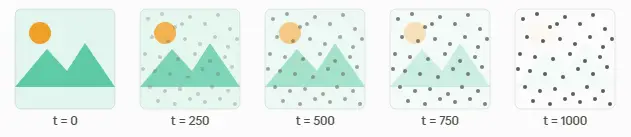
A simple real-world example is restoring an old photograph. Imagine you have a clear photo that slowly fades over time and becomes covered with static. If you carefully study how the damage happens, you can learn how to repair it step by step. Diffusion models work in a similar way. However, instead of restoring an existing photo, they learn how to turn pure static into completely new and realistic images.
The Evolution of AI Image Generation
Before we explore why diffusion models are a game-changing technology, let’s first understand the methods that came before them.
1. Early Image Generation Techniques
Early AI image generation used rule-based systems and simple statistical models. These early systems could create only basic textures and patterns. However, they could not understand objects, faces, or real-world scenes. As a result, the images looked abstract and unrealistic. They were not useful for serious creative work or commercial applications.
2. Variational Autoencoders (VAEs)
Variational Autoencoders (VAEs) first appeared in the early 2010s. They were among the first AI models that could generate images by learning from data. A VAE works by compressing an image into a small set of numbers, known as a latent representation. It then uses this compressed information to rebuild the original image. This approach was a major breakthrough at the time. However, VAEs often produced blurry images. That’s because the model tends to smooth out small details to maintain mathematical stability.
3. Generative Adversarial Networks (GANs)
In 2014, GANs changed AI image generation forever. They introduced a new approach that used two neural networks working against each other.
The first network, called the generator, creates fake images. The second, known as the discriminator, checks whether those images are real or fake. As both networks compete, they keep improving. Over time, this process helps the generator create highly realistic and detailed images.
For several years, GANs became the leading technology for AI image generation. They powered advanced models like StyleGAN, which can produce incredibly realistic human faces.
However, GANs also had a major drawback. Training them was often difficult and unstable. Both networks had to improve at the right pace. If one became much stronger than the other, the training process could fail.
As a result, GANs often suffered from a problem called mode collapse. Instead of creating a wide variety of images, the generator produced many images that looked almost the same. This limited the diversity of the final results.
4. The Birth of Diffusion Models
The idea behind diffusion models first appeared in a 2015 research paper. The paper used concepts from non-equilibrium thermodynamics to build generative AI models. However, the technology was not practical at that time. Everything changed in 2020 when researchers introduced Denoising Diffusion Probabilistic Models (DDPM). This breakthrough showed that diffusion models could generate images with quality equal to, and later even better than, Generative Adversarial Networks (GANs).
Why Diffusion Models Became the New Standard
Diffusion models solved many of the biggest challenges in generative AI at the same time. Unlike GANs, they have a much more stable training process because they do not rely on two competing networks. As a result, they are easier to train and produce more reliable results.
In addition, diffusion models create a wider variety of images. They start with random noise, but the denoising process can follow many different paths. This allows the same starting point to generate many unique outputs.
Because of these strengths, diffusion models quickly became the foundation of AI image generation. Their excellent text-to-image performance also played a major role. By 2022, they powered popular tools such as DALL-E 2, Midjourney, and Stable Diffusion, making AI-generated images more realistic and accessible than ever.
How Diffusion Models Work
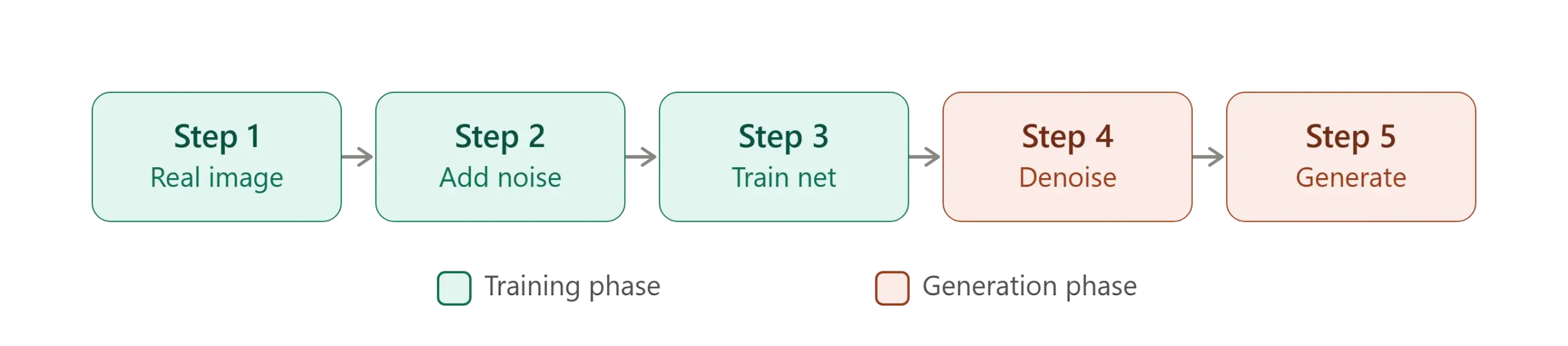
At a high level, diffusion models follow five main steps during training and image generation. Once you understand this process, the rest of the technology becomes much easier to follow.
Step 1: Start with a Real Image
The process begins with a large collection of real images. These images can include photographs, digital artwork, or illustrations. During training, each image acts as a reference example. It teaches the model what a clear, realistic, and meaningful image should look like.
Step 2: Forward Diffusion (Adding Noise)
Next, the model slowly adds random Gaussian noise to each image. It does this over many small steps, often around 1,000 or even more. With every step, the image becomes a little noisier. Eventually, the original picture disappears completely. At the final stage, it looks like random television static with no visible details.
Step 3: Train the Neural Network
Now the learning begins. At every noisy stage, the neural network—usually based on a U-Net architecture—tries to predict how much noise was added. Instead of creating images from scratch, the model focuses on recognizing and estimating the noise. Over time, it becomes highly skilled at separating noise from real image details.
Step 4: Reverse Diffusion (Removing Noise)
After training, the process works in reverse. This time, the model starts with a completely random noise image. Then, it predicts the noise in that image and removes a small amount of it. As this step repeats hundreds or even thousands of times, the image becomes clearer. Little by little, random static transforms into a recognizable picture.
Step 5: Generate the Final Image
Finally, after the reverse diffusion process is complete, the model produces a finished image. If a text prompt guides the process, the image matches that description. For example, if you enter “a cat wearing sunglasses on a beach,” the model gradually creates an image that reflects exactly that scene.
Understanding Forward Diffusion
Gaussian Noise
Forward diffusion starts by adding Gaussian noise to an image. This noise follows a bell-shaped pattern that is common in statistics. Although it looks random, it follows clear mathematical rules.
Scientists use Gaussian noise because it is predictable and easy to work with. More importantly, its mathematical properties allow the AI model to learn how to reverse the process later. This makes it an ideal choice for diffusion models.
Noise Schedules
Diffusion models do not add all the noise in one step. Instead, they follow a noise schedule, which controls exactly how much noise is added at each stage.
As a result, the image changes little by little instead of all at once. Researchers discovered that this gradual approach produces much better results. It gives the model a clear learning signal at every step, making training more stable and effective.
Mathematical Intuition (Simple Explanation)
You do not need advanced mathematics to understand the basic idea.
At each step, the model mixes a small part of the original image with a small amount of random noise. In the beginning, most of the image remains unchanged. However, with every new step, the image contributes less, while the amount of noise increases.
Eventually, almost every detail disappears, and the image becomes pure noise. Since this transformation happens gradually, the model can later learn to reverse each step. If all the noise were added at once, recovering the original image would be much more difficult.
Why Does Destroying an Image Help AI Learn?
At first, it may sound strange that damaging an image helps AI create realistic pictures. However, this process is actually the key to successful learning.
During training, the model knows exactly which noise was added at every step. Therefore, it always has a correct answer to compare its predictions against. This creates a clear and reliable learning signal.
In contrast, Generative Adversarial Networks (GANs) learn differently. In GANs, two neural networks compete with each other, so the correct answer keeps changing throughout training. As a result, training often becomes less stable.
Because diffusion models always know the exact noise added, they learn in a more stable, consistent, and reliable way.
Understanding Reverse Diffusion
Predicting the Noise
Reverse diffusion starts with a neural network. It looks at a noisy image and predicts the noise hiding inside it. This prediction is the most important step in the entire process. In fact, every other step depends on how accurately the model identifies that noise.
Removing Noise Step by Step
Instead of removing all the noise at once, the model works gradually. It removes a small amount of noise, checks the updated image, and then repeats the process. This step-by-step approach produces much better results. It also lets the model fix small mistakes along the way instead of making one large and risky correction.
Revealing Meaningful Patterns
As the noise disappears, the image slowly takes shape. First, you see rough outlines, large color areas, and the overall composition. Then, with each new step, the details become clearer. Textures, edges, facial features, and small objects begin to appear. In many ways, this process is similar to how an artist creates a drawing. They start with a rough sketch and then gradually add finer details.
Creating the Final Image
Finally, after completing all the denoising steps, the model produces a clear and realistic image. When a text prompt guides the process through techniques such as cross-attention (explained below), the final image closely matches the objects, ideas, and artistic style described in that prompt.
Key Components of a Diffusion Model
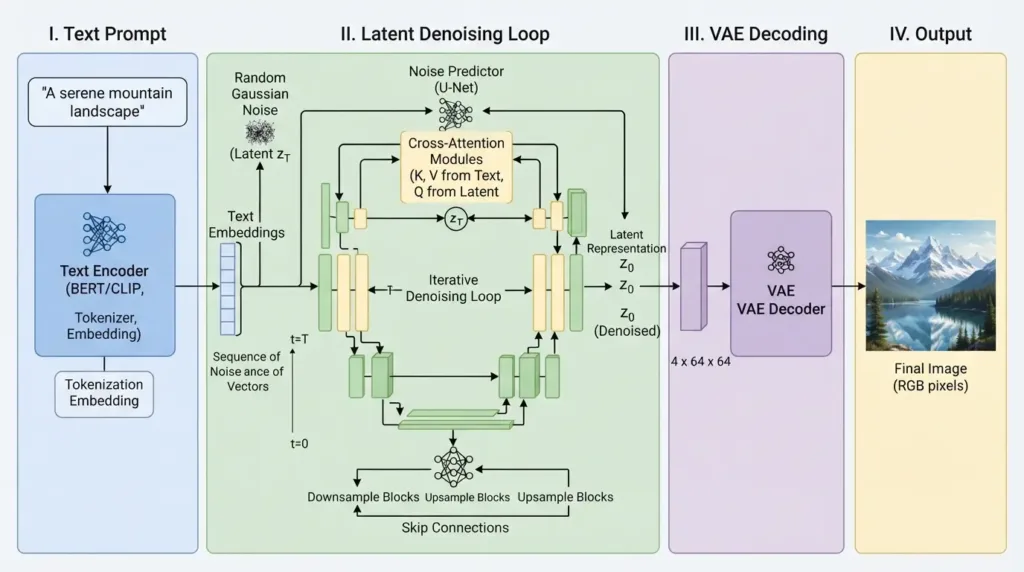
A diffusion model is not just one algorithm. Instead, it is a complete system made up of several specialized parts. Each component has a specific job, and together they create high-quality AI-generated images.
U-Net
The U-Net is the core neural network that predicts and removes noise from images. It gets its name from its U-shaped design. First, it compresses the image through several layers. Then, it rebuilds the image by expanding it back to its original size.
At the same time, special skip connections link matching layers on both sides of the network. As a result, the model keeps important image details while also understanding the overall structure. This design helps U-Net capture both large patterns and fine details with high accuracy.
Noise Scheduler
The noise scheduler controls how noise is added during training and removed during image generation. In other words, it guides the entire diffusion process.
Different scheduling methods, such as DDPM, DDIM, and Euler-based schedulers, produce different results. Some generate images faster, while others focus on improving image quality.
Text Encoder
Text-to-image diffusion models also include a text encoder. This component converts your written prompt into numbers that the AI model can understand.
Most modern models use CLIP or a similar vision-language model for this task. As a result, the model captures the meaning of your prompt and uses it to guide the image generation process.
Cross-Attention
Cross-attention connects the text prompt with the image generation process. It allows the U-Net to focus on the right words while creating different parts of the image.
For example, if your prompt says “a dog wearing a red hat,” cross-attention helps the model place the red hat on the dog instead of mixing up the objects or their colors. Because of this, the final image matches the prompt much more accurately.
Latent Space
Latent space is a compact mathematical representation of an image. Instead of storing every pixel, it keeps only the most important features.
This smaller representation makes the model much more efficient. As a result, it can generate images faster while using less computing power. The role of latent space becomes even clearer in the next section.
Variational Autoencoder (VAE)
Latent diffusion models use a Variational Autoencoder (VAE) to work with latent space.
First, the VAE compresses a full-resolution image into its compact latent representation. After the diffusion process is complete, it converts that latent data back into a detailed image.
In simple terms, the VAE acts like a translator. It helps the model work in its efficient “thinking space” while still producing a clear, high-resolution image that people can view.
Diffusion Models vs GANs
| Feature | Diffusion Models | GANs |
|---|---|---|
| Training Stability | Highly stable; no adversarial balancing needed | Often unstable; prone to mode collapse |
| Image Quality | State-of-the-art, especially at high resolution | Very high, but can plateau or degrade with instability |
| Diversity | Strong diversity across outputs | Prone to limited diversity (mode collapse) |
| Speed | Slower (multiple denoising steps) | Very fast (single forward pass) |
| Computational Cost | High during both training and inference | High during training; low during inference |
| Typical Applications | Text-to-image, inpainting, video generation | Face generation, style transfer, real-time applications |
| Strengths | Stability, diversity, flexible conditioning | Speed, sharpness in narrow domains |
| Weaknesses | Slow inference, resource-intensive | Training instability, limited diversity |
In short, GANs can generate images almost instantly. However, they are often difficult to train and may produce repetitive or limited results. In contrast, diffusion models take more time to create an image. Even so, they are easier to train, more stable, and capable of generating a much wider variety of high-quality images. This balance between speed and quality has made diffusion models the preferred choice for most modern AI image generation applications.
Diffusion Models vs CNNs
It is important to understand that diffusion models and Convolutional Neural Networks (CNNs) are not competing technologies. Instead, they work together. In fact, many diffusion models use CNNs as a core part of their architecture rather than as an alternative approach.
Purpose: CNNs are mainly built to recognize and classify patterns in data. For example, they can identify objects, faces, or animals in an image. In contrast, diffusion models create brand-new content, such as images that have never existed before.
Architecture: CNNs rely on convolutional layers to detect visual features like edges, textures, and shapes. Meanwhile, diffusion models usually use a U-Net, which is largely built from convolutional layers. In addition, text-to-image diffusion models include attention mechanisms to better understand text prompts and image details.
Training Objective: CNNs learn by reducing classification or detection errors during training. On the other hand, diffusion models learn to predict and remove the noise added to an image at every diffusion step. As a result, they gradually reconstruct a clear image from random noise.
Output: A CNN usually produces a prediction, such as a class label or a detected object. However, a diffusion model generates a completely new image from scratch.
How They Work Together: CNNs and diffusion models complement each other instead of competing. The convolutional layers inside a diffusion model help it understand visual patterns and image structures. Because of this, learning how CNNs process images makes it much easier to understand how the U-Net in a diffusion model works. If you want to explore this topic further, read our related article, Convolutional Neural Networks: The Science Behind How Machines See.
Diffusion Models vs Transformers
| Feature | Diffusion Models | Transformers |
|---|---|---|
| Architecture | Iterative denoising network (often U-Net based) | Attention-based sequence processing architecture |
| Data Processing | Processes noisy image data across many steps | Processes sequences of tokens (words, patches) in parallel |
| Strengths | Excellent for high-fidelity generative image and video tasks | Excellent for language understanding, long-range context, and sequence tasks |
| Weaknesses | Slower, multi-step inference process | Can be computationally heavy at very long sequence lengths |
| Common Applications | Image generation, video generation, audio synthesis | Language models, translation, and increasingly, vision tasks |
Interestingly, these two architectures are starting to blend together. Instead of relying only on the U-Net, many modern diffusion models now use or combine it with transformer-based architectures. These models are known as Diffusion Transformers (DiT). They bring together the powerful image generation of diffusion models and the excellent pattern recognition and scalability of transformers. As a result, this combination is widely expected to shape the next generation of AI models for image and video generation.
Real-World Applications of Diffusion Models
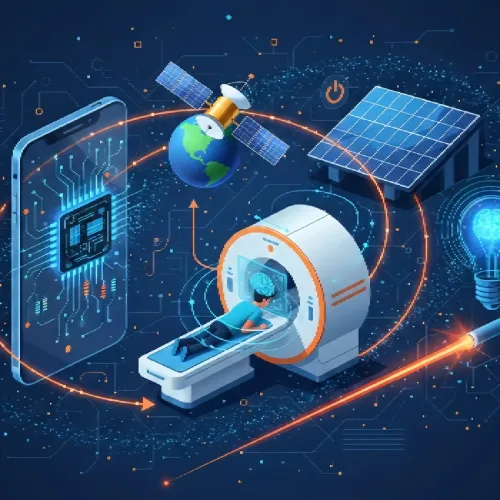
Diffusion models are no longer limited to AI art experiments. Today, they power many real-world applications across creative industries, healthcare, science, and engineering.
AI Art: Artists, designers, and hobbyists use diffusion models to create illustrations, concept art, and stylized images within seconds. These AI-generated visuals often serve as the first draft for further editing and creative improvement.
Product Design: Product designers use diffusion models to quickly create design concepts, packaging ideas, and multiple product variations. As a result, they can test ideas faster before investing in expensive physical prototypes.
Game Development: Game studios rely on diffusion models to generate textures, concept art, environment designs, and character concepts. This speeds up the early stages of game development and gives artists more ideas to explore.
Film Industry: Filmmakers use diffusion-based tools to create storyboards, design visual effects, and even generate short AI-powered video clips. Consequently, production teams can visualize scenes much earlier in the creative process.
Medical Imaging: In healthcare, researchers use diffusion models to improve MRI and CT scans. These models remove noise, enhance image quality, and reconstruct missing details. This leads to clearer medical images and can even reduce scanning time.
Drug Discovery: Scientists use diffusion models to design new molecules with specific chemical properties. Therefore, researchers can identify promising drug candidates more quickly and speed up the early stages of pharmaceutical research.
Protein Structure Prediction: Researchers also apply diffusion models to generate and refine 3D protein structures. This supports ongoing advances in computational biology and helps scientists better understand how proteins function.
Satellite Image Enhancement: Diffusion models improve satellite images by sharpening details, removing noise, and reconstructing damaged areas. As a result, they support environmental monitoring, disaster management, and geographic analysis.
Scientific Research: Beyond image generation, scientists use diffusion models to simulate physical systems and create realistic synthetic datasets. These datasets help researchers test ideas when real-world data is limited or difficult to collect.
Robotics: Modern robots increasingly use diffusion models to plan movements and perform complex tasks. Instead of following fixed instructions, they can generate action sequences that help them interact more effectively with their environment.
3D Object Generation: Diffusion techniques can also generate realistic 3D objects and shapes. These models are valuable for game development, animation, virtual reality (VR), and product visualization.
Video Generation: Researchers have extended diffusion models to generate videos from text prompts. By modeling both space and time, these systems can produce short video clips with smooth and consistent motion.
Audio Generation: Diffusion models are also transforming audio creation. They can generate music, sound effects, and natural-sounding speech by applying the same noise-removal process used for images to audio signals.
Advantages of Diffusion Models
High-Quality Images: Diffusion models consistently produce sharp, detailed, and photorealistic outputs, often surpassing older generative techniques.
Stable Training: Without an adversarial component to balance, diffusion models train more predictably and reliably than GANs.
Better Diversity: Diffusion models are less prone to mode collapse, producing a wider variety of outputs even from similar prompts.
Fewer Artifacts: The gradual, iterative denoising process tends to produce fewer visual glitches and distortions compared to single-pass generative approaches.
Flexible Architecture: Diffusion models can be conditioned on text, images, sketches, or other inputs, making them adaptable across many creative and technical use cases.
Strong Conditioning Capabilities: Techniques like cross-attention allow precise control over generated content, enabling detailed prompt-following and fine-tuned creative direction.
Ethical Challenges of Diffusion Models
1.Copyright Issues
Diffusion models learn from huge collections of existing images. Many of these images include copyrighted artwork and photographs. As a result, this technology has sparked legal and ethical debates. Many people question whether creators should give consent or receive compensation. Others also wonder whether it is fair when AI generates images that closely match the style or content of the original work.
2. Deepfakes
Diffusion models can create stunning artwork. However, the same technology can also produce highly realistic fake images and videos of real people. These deepfakes raise serious concerns about misinformation, privacy, consent, and personal harm.
3. Bias in Training Data
Diffusion models learn from real-world data. Therefore, they can also learn the biases hidden in those datasets. As a result, AI may generate unfair or stereotypical representations of people, cultures, or professions. Reducing these biases remains an important challenge.
4. AI Safety
As diffusion models become more advanced and widely available, the risk of misuse also increases. For example, they could be used to create harmful content, non-consensual images, or misleading information. Because of this, researchers continue to develop better safety measures and responsible policies.
5. Responsible AI Development
Many organizations are now working to make diffusion models safer and more responsible. They are introducing content filters, watermarking AI-generated images, and creating clear usage guidelines. Together, these safeguards help reduce misuse while encouraging the ethical development of AI.
The Future of Diffusion Models
Diffusion models are improving at an incredible pace. Researchers continue to solve their current limitations while unlocking exciting new possibilities. Here are some of the biggest trends shaping their future.
Faster Diffusion Algorithms
One major goal is speed. Today, researchers are developing new methods that need far fewer denoising steps. As a result, image generation is becoming much faster, dropping from dozens of steps to only a few.
Consistency Models
Another promising development is consistency models. These models can produce high-quality results in just one step or a small number of steps. This approach helps overcome one of the biggest weaknesses of traditional diffusion models—their slow generation speed.
Flow Matching
Flow matching is another exciting research direction. Instead of using the traditional diffusion process, it follows a different mathematical approach to train generative models. Because of this, it can be more efficient while still producing excellent results.
Rectified Flow
Rectified flow builds on a similar idea. It creates a straighter path between random noise and the final output. Therefore, the model needs fewer steps to generate realistic, high-quality content.
Multimodal Diffusion
Future diffusion models will become more versatile. Instead of working with only one type of data, they will process text, images, audio, and video together in a single unified system. This will make AI applications more powerful and flexible.
World Models
Researchers are also building diffusion-based world models. These systems can simulate complete, dynamic environments instead of creating a single image. As a result, they could support major advances in robotics, video games, and autonomous machines.
AI Video Generation
Diffusion models are already transforming AI video generation. As the technology improves, videos will become longer, smoother, and more realistic. They will also maintain better consistency from one frame to the next.
Scientific Discovery
The impact of diffusion models goes beyond creative content. Scientists are using them to explore new materials, chemical compounds, and biological structures. These AI-generated ideas can then be tested by researchers or automated systems, speeding up scientific discovery.
Personalized Image Generation
Personalization is another fast-growing area. New fine-tuning techniques allow diffusion models to learn specific artistic styles, faces, or brand identities. As a result, businesses and creators can generate highly personalized, consistent content on a much larger scale.
Conclusion
Diffusion models are one of the biggest breakthroughs in modern generative AI. They learn how to reverse a carefully controlled noise-adding process. As a result, they create high-quality, diverse, and realistic images. Unlike earlier models such as VAEs and GANs, diffusion models deliver more stable and consistent results.
Because of this advancement, generative AI has grown from an exciting research idea into a practical technology. Today, artists, designers, scientists, and businesses use it every day. In addition, innovations like latent diffusion have made these models faster and more efficient. Meanwhile, Stable Diffusion has made text-to-image generation accessible to millions of people. These breakthroughs are now driving progress in video generation, audio creation, scientific research, and even robotics.
Research is also moving quickly. New approaches aim to make diffusion models faster, smarter, and more efficient. At the same time, consistency models and multimodal AI systems are expanding what these models can do. As a result, diffusion models will likely play an even bigger role in creative work and scientific discovery. Understanding how they work today gives you a strong foundation for understanding the future of AI-generated media.
Frequently Asked Questions
A diffusion model is a generative AI model that creates new images (or other data) by learning to reverse a process of gradually adding random noise to training data, then using that learned skill to transform pure noise into a coherent output.
Stable Diffusion converts a text prompt into a numerical embedding, then uses that embedding to guide a denoising process within a compressed latent space, before decoding the result into a final, full-resolution image.
Yes. By extending the diffusion process across both space and time, researchers have developed diffusion-based models capable of generating short, coherent video clips from text or image prompts.
Latent diffusion is a technique where the noising and denoising process happens in a compressed, lower-dimensional representation of an image rather than on raw pixels, dramatically improving speed and memory efficiency.
Adding noise creates a controlled, reversible learning problem. By training a model to accurately predict and remove noise at every step, it develops a deep understanding of realistic image structure, which it can then use to generate new images from scratch.
Recommended Resources for Curious Minds
For readers who want to go deeper, the following books available on Amazon provide clear explanations and practical insights:
- Generative Deep Learning by David Foster – A practical guide that covers autoencoders, GANs, and diffusion-style approaches with code examples. Check out here!
- Hands-On Machine Learning with Scikit-Learn, Keras, and TensorFlow by Aurélien Géron – Offers solid foundations in the neural network techniques that underpin modern generative models. Check out here!
- Deep Learning by Ian Goodfellow, Yoshua Bengio, and Aaron Courville – A comprehensive reference for understanding the mathematical and conceptual background of generative modeling. Check out here!
- A dedicated GPU-equipped laptop or desktop workstation — For readers interested in experimenting with open-source diffusion tools like Stable Diffusion locally, sufficient GPU memory makes a significant difference in speed and usability. Check out here!