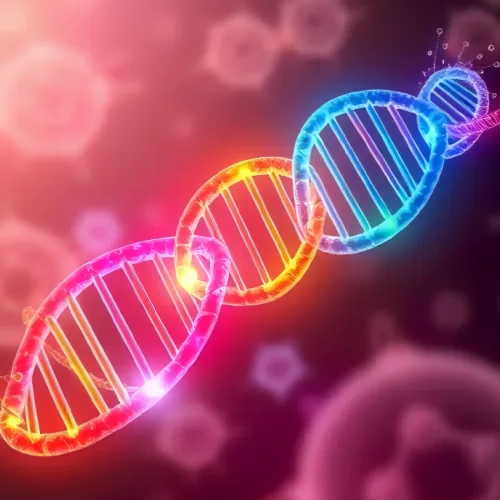
Biology has a lot of moving parts. Pathways on pathways, weird names, arrows everywhere. But there’s one rule that shows up so often it’s basically the backbone of everything else. If you get this, most “gene” stuff starts to feel… not easy, but at least readable. It’s called the central dogma of life.
And yes, it sounds intense. It’s actually pretty simple.
What Is the Central Dogma of Life?
The central dogma is the core rule for how genetic information usually flows inside cells:
DNA → RNA → Protein
That’s it. That’s the rule.
But here’s the part people miss. This is about information transfer, meaning the sequence. The order of letters in DNA gets copied into RNA, and then that order gets converted into the order of amino acids in a protein. It’s not just “DNA makes proteins.” It’s more like a relay race where the baton is information.
A one sentence mental model that actually works:
DNA stores the instructions, RNA copies and carries the instructions, proteins do the work.
In this article, we’ll walk through the full pipeline, the two big steps that make it happen, and the stuff that gets misunderstood all the time. Gene expression. Transcription. Translation. Why one cell type can act totally different from another even with the same DNA. The usual confusions.
Why The Central Dogma of Life Matters: Real-World Examples and Everyday Applications
If you ever wonder how a trait happens, like eye color, lactose intolerance, sickle cell disease, muscle growth, height tendencies, whatever. It usually comes back to proteins.
Because proteins are what cells use to build and run your body.
So the central dogma is basically how your genotype becomes phenotype. Your DNA sequence matters because it affects RNA and proteins, and proteins change what a cell can actually do.
You see it in medicine and biotech constantly:
| Real-Life Example | DNA Role | RNA Role | Protein Role |
|---|---|---|---|
| Genetic Testing | Detect mutations | May alter expression | Changes protein function |
| mRNA Vaccines | DNA not directly used | Delivered mRNA | Produces viral protein fragment |
| Antibiotics | Target bacterial genes indirectly | Target translation process | Stop protein production |
| Inherited Diseases | Mutated DNA | Altered mRNA | Defective proteins |
Practical payoff. If you can follow DNA → RNA → protein, you can follow most headlines that say “Scientists discovered a gene for X.” What they usually mean is “Scientists found a DNA variation that changes a protein, or changes gene expression, and that affects X.”
The three main players: DNA, RNA, and proteins
Let’s label the cast.
DNA
Double stranded, long term storage. It’s stable, it lives in the nucleus in eukaryotes, and it holds genes. Think library archive. You do not drag the original manuscript around if you can avoid it.
RNA
Usually single stranded, more temporary, more flexible. There are multiple types of RNA, and a lot of them do different jobs, but the main one people mean in the central dogma is mRNA (messenger RNA). RNA is the copy, the working document.
Proteins
Chains of amino acids that fold into specific 3D shapes. And that shape is the whole point. Proteins act as enzymes (speeding up reactions), structural materials, transporters, receptors, signals, motors. They are the “do stuff” molecules.
A key bridge idea here is:
Sequence → structure → function.
DNA and RNA are sequences of nucleotides. Proteins are sequences of amino acids. The amino acid sequence folds into a structure. The structure determines function. That’s how a letter level change in DNA can end up as a body level change in you.
Step 1 — DNA: The Source Code of Life and What a Gene Really Is
People say “a gene” like it’s one neat chunk of DNA that directly turns into one protein.
Real life is messier.
A gene often includes:
- A coding region, the part that contains the instructions for the amino acid sequence.
- Regulatory DNA, like promoters and enhancers, which control when, where, and how strongly the gene is used.
So a gene is not just the protein recipe. It’s also the control panel for that recipe.
Also, not all DNA becomes protein. Even within genes, there are parts that won’t end up translated. Plus, huge portions of genomes are regulatory or structural or have functions we are still mapping out. The useful beginner version is: DNA contains both instructions and switches.
One more setup concept that matters later: DNA and RNA have direction. You’ll often see 5 prime to 3 prime written as 5’ → 3’. You don’t need the chemistry right now. Just know that copying and reading happen in a consistent direction, like reading a sentence left to right.
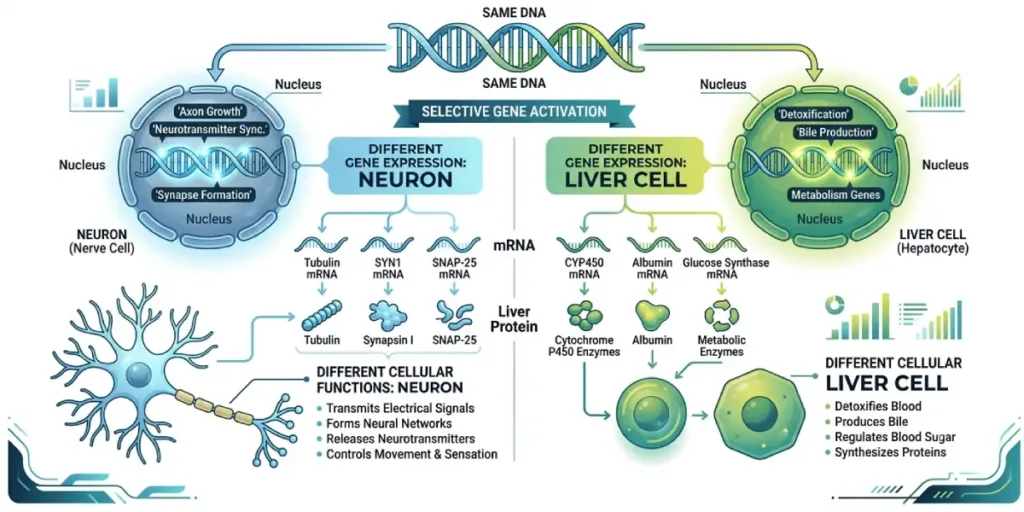
And finally. Cells do not use the whole genome at once. They are picky. A skin cell expresses skin related genes. A neuron expresses neuron genes. The DNA is mostly the same, the output is different.
That leads us to the master idea.
Gene Expression in the Central Dogma of Life: How Transcription and Translation Control Protein Synthesis
Gene expression is the process of using the information in a gene to make a functional product. Usually that product is a protein. Sometimes it’s a functional RNA (an RNA that does a job directly without becoming a protein).
One of the biggest beginner mistakes is confusing:
- “This gene is in the DNA”
- “This gene is expressed”
Every cell in your body (with some exceptions like mature red blood cells) has basically the same DNA. But not every cell is making the same RNA or the same proteins.
Expression is regulated at multiple stages:
- Before and during transcription (whether RNA gets made)
- RNA processing (how the RNA is edited)
- RNA stability (how long it survives)
- Translation (how efficiently it gets turned into protein)
- After translation (protein folding, modification, degradation)
Simple example. Liver cells and neurons share the same genome, but they produce different sets of proteins, so they behave like totally different machines. That’s gene expression in action.
Now we go through the pipeline.
Step 2 — Transcription: how DNA is copied into RNA
Transcription is making an RNA copy from a DNA template.
The main enzyme is RNA polymerase. Its job is to bind DNA, open a small section, and build an RNA strand by matching bases.
At a beginner friendly level, transcription has three stages:
- Initiation: RNA polymerase binds to a promoter near the start of a gene.
- Elongation: it moves along the DNA and builds the RNA strand.
- Termination: it hits a stop signal and releases the RNA.
One detail that clears up confusion fast: DNA has two strands, but only one is used as the template for a given gene at a given time.
You may hear:
- Template strand: the DNA strand RNA polymerase reads.
- Coding strand: the DNA strand that matches the RNA sequence, except DNA has T and RNA has U.
So the RNA sequence is basically the coding strand with U swapped in for T.
And transcription is selective. Cells do not transcribe everything. Transcription factors and signals decide which genes get copied right now, in this cell, under these conditions.
Where Does Transcription Occur in The Central Dogma of Life?
Location depends on the type of organism.
Eukaryotes (humans, plants, fungi)
Transcription happens in the nucleus. Then the RNA has to be processed and exported to the cytoplasm for translation.
Prokaryotes (bacteria, archaea)
No nucleus. Transcription happens in the same general space where ribosomes are. So transcription and translation can be coupled, meaning ribosomes can start translating an mRNA while it’s still being transcribed.
Why this matters. Bacteria can respond fast. Humans have more layers of control. More regulation, more checkpoints, more opportunities for things to go wrong, but also more fine tuning.
RNA processing (eukaryotes): the “rough draft” gets edited
In eukaryotes, the first RNA copy is often called pre mRNA. It’s not ready yet. It needs editing.
There are three core modifications you’ll see everywhere:
- A 5’ cap added to the beginning
- A poly A tail added to the end
- Splicing, where pieces are removed and the remaining parts are stitched together
Splicing introduces introns and exons:
- Exons are the parts that usually stay in the final mRNA.
- Introns are the parts that get removed.
And then there’s alternative splicing, which is a huge reason biology is not as simple as “one gene equals one protein.” The same gene can be spliced in different ways to make different mRNA versions, which can produce different protein variants.
Important point though. This is still central dogma. It’s still DNA → RNA. The RNA just goes through a serious editing phase first.
Step 3 — Translation: how RNA becomes a protein
Translation is when a ribosome reads mRNA and assembles amino acids into a polypeptide chain.
You need four main components:
- mRNA: the message
- Ribosome: the machine that reads the message
- tRNA: adapters that bring amino acids
- Amino acids: the building blocks
The ribosome reads the mRNA in groups of three nucleotides called codons. Each codon corresponds to an amino acid (or a stop signal).
There’s usually a start signal. The common start codon is AUG, which codes for methionine.
Then translation runs through three stages, conceptually similar to transcription:
- Initiation: ribosome assembles at the start codon
- Elongation: codon by codon, amino acids are added in the correct order
- Termination: a stop codon appears, the chain is released
Accuracy matters because protein function depends on amino acid order. The codon in mRNA pairs with an anticodon on a tRNA. That matching is the quality control step that keeps the sequence right most of the time.
The genetic code: how 4 letters specify 20 amino acids
RNA has 4 letters: A, U, C, G.
So why codons are triplets is partly math. If you use 3 positions and 4 options each time, you get:
4³ = 64 codons
That’s more than enough to cover 20 amino acids. Which leads to a feature called degeneracy (redundancy). Multiple codons can code for the same amino acid.
This matters when we talk about mutations. A change in DNA might:
- Be silent: codon changes but amino acid stays the same
- Be missense: codon changes and amino acid changes
- Be nonsense: codon becomes a stop codon, making a shorter protein
That’s why a single base change can do nothing, or it can wreck a protein, or it can create a disease. Depends on where it happens and what it changes.
For more detailed information about these processes, including aspects such as the role of mutations in genetic coding and protein synthesis, further reading is recommended.
After translation: proteins must fold and sometimes get modified
Translation makes a chain. A raw string of amino acids.
But proteins only work when they fold into the right 3D shape. Folding is driven by chemistry and helped by chaperone proteins in many cases.
Then there are post translational modifications, which is a fancy way of saying proteins often get extra chemical tags or changes after they’re made. Examples include:
- Phosphorylation (common in signaling)
- Glycosylation (common in secreted and membrane proteins)
Also, proteins have to end up in the correct place. Some stay in the cytoplasm. Some go to the nucleus. And some get shipped out of the cell. So even after translation, there’s still logistics.
This is part of why proteins feel like the “end product” in the central dogma. They are the molecules that actually execute.
Putting it together: DNA → RNA → Protein as a simple pipeline
Let’s use insulin as a clean example.
- DNA contains the insulin gene, including regulatory sequences that decide when insulin should be made.
- In pancreas beta cells, signals like rising blood glucose lead to increased gene expression of insulin.
- The insulin gene is transcribed into pre mRNA in the nucleus.
- The RNA is processed. Capped, tailed, spliced. Now it’s mature mRNA.
- The mRNA leaves the nucleus and goes to ribosomes.
- Ribosomes translate the mRNA into an insulin polypeptide (actually a precursor that gets processed further).
- The protein folds and is modified and packaged so it can be secreted.
- Insulin is released and helps cells take up glucose.
Two things to notice.
First, the flow is exactly central dogma. DNA → RNA → protein.
Second, you can change biology without changing DNA sequence. If the cell makes more insulin mRNA, you get more insulin protein. If it makes less, you get less. Regulation matters as much as the letters.
Vocabulary check, because these words come up constantly: gene, mRNA, ribosome, amino acids, protein function. That’s the pipeline.
Common Myths and Misconceptions About The Central Dogma of Life
Misconception: All DNA becomes protein.
No. Some genes produce functional RNAs. A lot of DNA is regulatory. Some DNA has structural roles. Only a fraction of the genome is protein coding in many organisms, including humans.
Misconception: One gene equals one protein, always.
Not always. Alternative splicing can create multiple mRNAs from the same gene. Proteins can also be cut, modified, combined into complexes. “One gene one protein” is a historical stepping stone, not the full truth.
Misconception: The central dogma means information only flows one way in every situation.
The core flow is DNA → RNA → protein, yes. But biology has side routes. The central dogma is more like the default highway, not the only road that exists.
Important Exceptions, Extensions, and Modern Discoveries
A big one is reverse transcription.
Some viruses, like retroviruses, carry RNA and use an enzyme called reverse transcriptase to make DNA from RNA:
RNA → DNA
That DNA can then integrate into a host genome. That’s a real information transfer that goes opposite the usual direction.
Some viruses also do RNA → RNA replication. Their genome is RNA and they copy it directly.
What you basically do not see, in the central dogma sense, is protein → RNA or protein → DNA where protein sequence is used to write a nucleic acid sequence. Proteins do not serve as templates that get copied back into genes.
So the rule stands. Cellular life mostly runs DNA → RNA → protein, with special case pathways involving RNA that are important, but not the day to day default in your cells.
Where Transcription and Translation Are Regulated in The Central Dogma of Life
Most of biology is control.
Cells usually do not change their DNA. They change which genes are expressed, how much, and when. Like a dimmer switch, not just on and off.
Key checkpoints include:
- Chromatin accessibility in eukaryotes. DNA wrapped tightly around histones is harder to transcribe.
- Transcription factors that help RNA polymerase start or stop at specific genes.
- RNA processing choices, including alternative splicing.
- RNA stability. Some mRNAs are degraded quickly, others hang around.
- Translation efficiency. Some mRNAs get translated a lot, some barely.
- Protein degradation. Cells can destroy proteins to shut down a pathway fast.
This is the real reason two cells with the same DNA can behave like different species. They run different expression programs.
The Central Dogma of Life Explained: How DNA, RNA, and Proteins Work Together
Here’s the one line to keep in your head:
DNA stores information, RNA carries it, proteins execute it.
And the two key processes:
- Transcription: DNA → RNA
- Translation: RNA → protein
If you’re ever lost in a biology topic, zoom out and ask one question. Where is the information flowing right now.
If you can track that, you can understand most gene expression conversations, most mutation stories, most biotech news. Not all of it, biology still has plenty of weird corners. But you’ll have the main map.