
Over the past few years, astronomers have run into something both surprising and exciting. They have found Rapidly growing black holes. Some of these giants appeared just a few hundred million years after the Big Bang. Even more shocking, they are gaining mass at speeds that physics says should not happen. Classic theory claims that black holes grow slowly. Radiation pressure should push material away and keep growth in check. But the universe clearly didn’t read that rulebook.
This discovery matters a lot. Black holes sit at the center of galaxies and quietly control their evolution. They influence how stars form, how galaxies take shape, and how matter behaves over billions of years. So when observations clash this hard with theory, it’s not a small issue. It’s a red flag. It tells us something fundamental is missing from our understanding.
For many years, astronomers believed that black hole growth had a strict ceiling called the Eddington limit. Go beyond it, and radiation should shut everything down. Yet new data from powerful observatories like JWST and Chandra tell a different story. In the early universe, black holes seem to ignore this so-called speed limit. The mismatch between theory and reality is not subtle anymore. It’s obvious, persistent, and impossible to brush aside.
In this article, we will unpack where the old models fall short. We will explore what scientists think might be happening instead. And most importantly, we will see why this shift could change how we understand the universe itself.
Why Rapidly Growing Black Holes Matter More Than We Thought
Black holes are not just cosmic vacuum cleaners. They actively shape how the universe evolves. Almost every massive galaxy has a supermassive black hole at its center. Even more surprising, the mass of that black hole closely matches the mass of its host galaxy. That link should not exist unless both grow together over time.
Here’s where things get tricky. In the early universe—often called the cosmic dawn—there simply was not enough time for black holes to reach such enormous sizes using classical physics alone. Yet observations show something shocking. Some distant quasars already hold black holes larger than a billion Suns, even though the universe was less than a billion years old.
Traditional accretion models predict slow, steady growth. But the data tells a very different story. Growth was fast. Explosive, even. This gap between theory and observation leaves us with only two realistic options.
Either black holes were born much heavier than scientists once believed, or they grow through processes we still don’t fully understand.
Both possibilities are a big deal. They force us to rethink how black hole seeds form, how accretion disks behave, and how the first galaxies came together. In short, rapidly growing black holes are rewriting the rules of cosmic evolution.
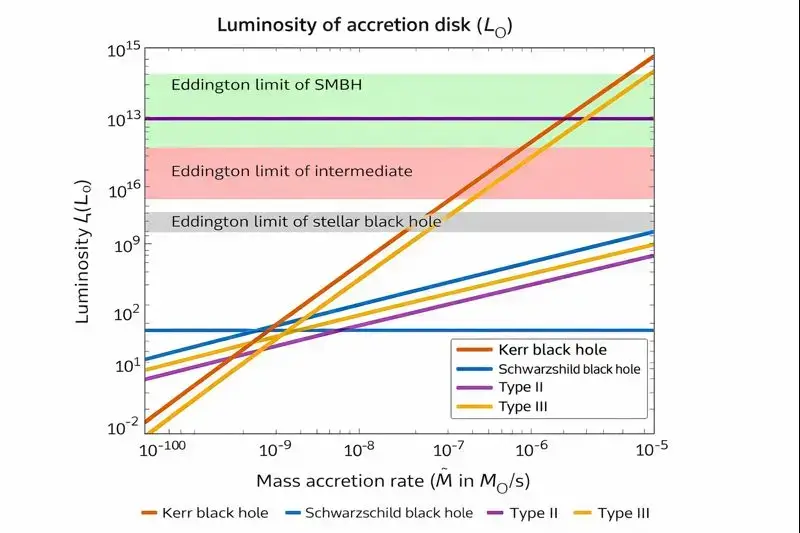
What Is the Eddington Limit?
The Eddington limit is a kind of cosmic balance point. When matter falls toward a black hole, it heats up fast and releases intense radiation. That radiation pushes outward, while gravity pulls inward. Eventually, these two forces cancel each other out. At that point, no extra matter can easily fall in.
From a math perspective, the Eddington limit depends on the black hole’s mass and a few fundamental constants. But the core idea is simple. It works like a feedback system. As more material rushes in, more light is produced. That extra light then pushes material away, slowing or even stopping further growth.
For decades, this concept has been a foundation of astrophysics. It fits well with what we see in stars, quasars, and X-ray binaries. More importantly, it explains why black holes grow at steady rates instead of instantly swallowing everything around them.
Why It Serves as a “Speed Limit” for Black Hole Growth
When a black hole pulls in matter beyond the Eddington limit, intense radiation should push the gas away. In theory, this pressure acts like a hard stop. That’s why scientists call it a cosmic speed limit. Anything faster was expected to fail quickly.
For a long time, growth beyond this limit was seen as rare. If it happened at all, it was thought to be unstable or short-lived. Yet the universe keeps proving otherwise. Again and again, it ignores the rule—and keeps growing anyway.
Observational Breakthroughs in Rapidly Growing Black Holes
Recent telescope observations have upended our understanding of black hole growth. They have revealed cosmic giants that follow completely different rules than we once thought.
LID-568: The 40× Overachiever
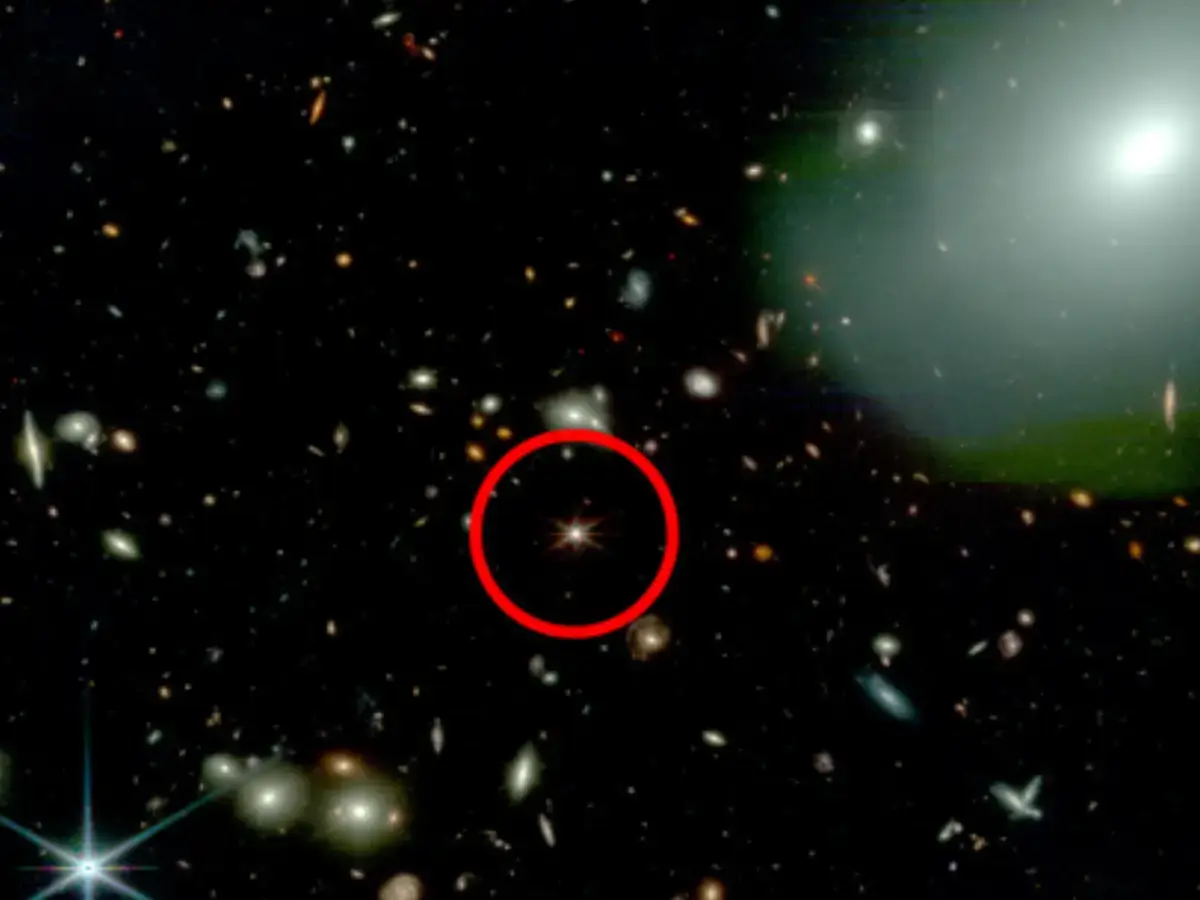
In a groundbreaking 2024 discovery, astronomers spotted LID-568, a black hole in the early universe, using NASA’s James Webb Space Telescope and Chandra X-ray Observatory. This black hole defies conventional growth models by feeding at roughly 40 times the classical limit, a phenomenon known as super-Eddington accretion. At a time when the universe was just a fraction of its current age, LID-568 shouldn’t even exist—yet there it is.
What makes LID-568 truly remarkable is not just its extreme appetite. Observations reveal powerful outflows of material hurtling at thousands of kilometers per second—a clear sign of super-Eddington accretion. Its X-ray emissions carry spectral fingerprints showing matter is falling in far faster than radiation pressure should allow.
To uncover these secrets, the team used infrared observations to peer through cosmic dust and measure the system’s immense energy output. By combining JWST’s unmatched infrared sensitivity with Chandra’s X-ray precision, astronomers captured a complete view of this extraordinary black hole’s feeding frenzy.
RACS J0320-35: Early Massive Growth
Shortly after LID-568 made headlines, another fascinating system appeared in survey data. RACS J0320-35 offers a different, yet equally puzzling, glimpse into rapid black hole growth in the early universe. This high-redshift quasar suggests that super-Eddington accretion isn’t a rare event—it could have been common during the universe’s infancy.
What makes RACS J0320-35, so striking is its timing. We see it as it was when the universe was less than a billion years old, yet this black hole had already amassed billions of solar masses. Standard Eddington-limited growth just can’t explain such rapid accumulation, even with generous assumptions about seed mass and continuous feeding.
Radio observations revealed powerful jets—streams of matter and energy blasting from its poles at near-light speed. Together with its brightness and spectral features, these jets point to a sustained period of super-Eddington accretion during the cosmic dawn.
JWST’s High-Redshift Revolution
The James Webb Space Telescope has spotted dozens of massive black holes from the early universe, shaking up our understanding of how they form. These discoveries aren’t rare exceptions—they point to a whole population that grew incredibly fast.
High-redshift quasar surveys reveal black holes weighing over a billion times the Sun’s mass, all before the universe even turned one. Studies show that standard Eddington-limited growth, even in perfect conditions, can’t explain how they got so big. The sheer number of these giants hints that super-Eddington growth might have been common in the early cosmos.
Follow-up spectroscopic observations reveal striking details in their light. Broad emission lines show gas racing at extreme speeds. Strange ionization patterns hint at powerful radiation, while unusual chemical compositions suggest rapid element formation in their galaxies.
Super-Eddington Accretion Explained
So how do these cosmic rule-breakers actually work? The physics of super-Eddington accretion reveals elegant solutions to an apparently impossible problem.
The Physics of Exceeding Limits
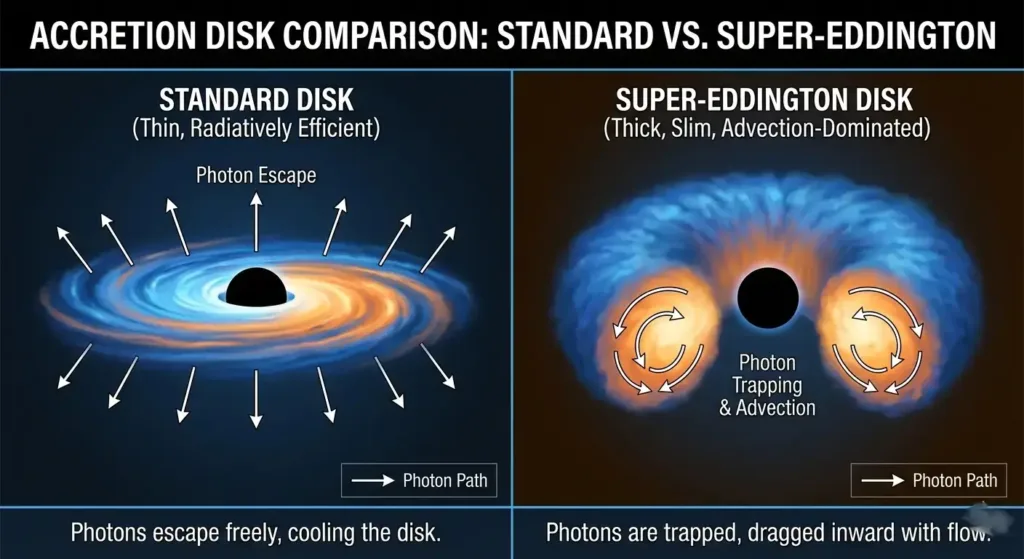
Traditional thin accretion disk models assume matter drifts inward slowly, letting orbital energy escape as radiation. This radiation creates outward pressure, enforcing the Eddington limit. But what happens when the accretion rate becomes extreme enough to change the system’s structure?
This is where super-Eddington accretion comes in. When matter falls faster than the Eddington limit allows, certain physical processes stop radiation from blowing the material away. The trick is that radiation gets trapped within the infalling matter, so it no longer acts as a brake on accretion.
The energy released during super-Eddington accretion is enormous—sometimes far beyond a black hole’s Eddington luminosity. Yet, much of this energy doesn’t escape as light. Instead, it’s carried inward with the matter in a process called advection-dominated accretion. This lets the black hole grow while keeping radiation from halting the inflow.
Slim Accretion Disks and Photon Trapping
The standard thin disk model fails at extreme accretion rates, giving way to “slim” or “thick” disk structures. These disks behave very differently from the classic thin disk.
In a slim disk, the flow puffs up instead of staying flat. This thicker shape creates a deep photon-trapping zone. Radiation generated inside the disk struggles to escape and often gets dragged past the event horizon. Vertically, the disk becomes optically thick, forming a radiation-pressure-supported structure that surprisingly allows even faster accretion.
Photon trapping skyrockets at high accretion rates. Once the inflow exceeds roughly three times the Eddington limit, over half the radiation gets trapped. At 40 times the Eddington rate—like in LID-568—almost all photons fail to escape. The black hole is basically consuming its own light.
This disk shape also powers strong polar outflows. While the equatorial regions funnel matter inward, radiation pressure pushes material outward along the rotational axis. This creates narrow jets and wide-angle winds. These outflows carry away angular momentum and energy, helping the disk feed the black hole even faster—a cosmic conveyor belt moving in both directions at once.
Observational Signatures
Detecting super-Eddington accretion means spotting signs that set it apart from normal Eddington-limited feeding. X-ray observations play a key role. Super-Eddington systems produce softer X-ray spectra than their regular counterparts, reflecting different conditions in the inner accretion flow. Their X-ray flickering is also faster and more chaotic, driven by the thick, turbulent disk.
Infrared and optical observations add more clues. Broad emission lines appear with complex velocity patterns. Powerful outflows create blueshifted absorption features, while the thick disk shapes emission line profiles in unique ways. Speeds in these winds can reach thousands of kilometers per second, pushed by intense radiation pressure.
The most striking sign comes from the luminosity-to-mass ratio. When astronomers measure a black hole’s mass through its galaxy or dynamics and compare it to its brightness, super-Eddington sources shine far beyond expectations. This “super-Eddington ratio” acts as a clear marker of rapid, extreme accretion.
Rapidly Growing Black Holes: Competing Growth Theories Explained
The discovery of super-Eddington accretion does not answer all the questions about early black hole growth. Several competing theories try to explain how supermassive black holes formed so fast after the Big Bang.
Direct Collapse Models
One clever idea sidesteps the slow-growth problem completely: what if some early black holes didn’t start small?
Direct collapse black hole models suggest that, in the early universe, massive gas clouds could collapse straight into black holes weighing 10,000 to 100,000 times the mass of the Sun—without forming any stars first. These “heavy seeds” would get a huge head start compared to regular stellar-mass black holes.
But the conditions for direct collapse are strict. The primordial gas must stay extremely hot—around 8,000 Kelvin—to avoid breaking into individual stars. This means molecular hydrogen, which normally cools the gas, must be suppressed. Intense ultraviolet light from nearby galaxies could do just that, creating rare but critical windows where direct collapse becomes possible.
Recent simulations hint that these heavy seeds may form mostly in regions that later evolve into galaxy clusters, the largest structures in the universe. If true, this could explain why today’s most massive black holes are often found in clusters. While the DCBH scenario is still speculative, it’s elegant—and future observations might finally spot these intermediate-mass black hole seeds in action.
Merger-Driven Growth
Black holes grow not only by pulling in matter but also by smashing into each other. When galaxies collide, their central black holes slowly spiral toward each other and merge, forming a much larger black hole almost instantly.
In the early universe, galaxy mergers were more common because cosmic structures were still forming. A single merger could double a black hole’s mass—far faster than even the fastest accretion could achieve over the same time.
But mergers come with their own timing hurdles. Black holes don’t merge immediately after their galaxies collide. First, they must lose energy and angular momentum, spiraling inward over millions of years through a process called dynamical friction. Only when they are extremely close—less than a parsec apart—do gravitational waves finally pull them together. This “final parsec problem” shows that mergers might not happen as quickly or as often as needed to explain the earliest supermassive black holes.
Recent pulsar timing observations have picked up a faint background hum of gravitational waves, likely from countless black hole mergers across cosmic history. This proves that mergers do happen, but researchers are still figuring out how much they actually contribute to the rapid growth of early black holes.
Rapidly Growing Black Holes – Simulations vs Real Universe
Cosmological simulations try to recreate the universe’s evolution on a computer, giving us a virtual lab to test growth theories. Yet, aligning these simulations with real observations remains surprisingly challenging.
What cosmological simulations show vs. actual data
Cutting-edge cosmological simulations like IllustrisTNG, EAGLE, and FIRE model black hole growth, feedback, and galaxy evolution in great detail. They track billions of particles representing dark matter, gas, and stars, following the universe from just after the Big Bang to today.
However, most simulations struggle to produce enough massive black holes at high redshift. To match observations, they often need to assume super-Eddington accretion or massive seed black holes. Even with optimistic assumptions, standard Eddington-limited growth creates black holes that are smaller than those seen in early quasars. To fix this, simulators increasingly include super-Eddington growth, highlighting that traditional models alone aren’t enough.
Recent studies show how super-Eddington accretion might naturally occur. Dense gas flows during galaxy mergers, cold streams of pristine cosmic gas, and instabilities in young galaxies can all funnel huge amounts of matter into central black holes. These findings suggest that super-Eddington growth may be a natural result of the chaotic, gas-rich environment in the early universe—not a rare or unknown process.
Limitations of Super-Eddington for Long-term Growth
While super-Eddington accretion solves some problems, it creates others. Sustaining such extreme feeding rates over cosmological timescales faces multiple challenges.
First, the fuel supply itself becomes an issue. Even gas-rich early galaxies contain finite amounts of available matter. Super-Eddington accretion consumes material so rapidly that black holes risk depleting their surroundings within tens of millions of years—much shorter than the hundreds of millions of years available in the early universe.
Second, powerful outflows generated during super-Eddington episodes can become self-limiting. These winds carry tremendous mechanical energy, heating and dispersing nearby gas. This “feedback” process can temporarily shut off accretion, forcing the black hole into a starvation period. The duty cycle—the fraction of time spent actively feeding—becomes crucial for understanding long-term growth rates.
Recent studies suggest super-Eddington accretion might occur in short, intense bursts rather than continuous epochs. A black hole might feed at 10-40 times the Eddington limit for just 10% of the available time, with the remaining 90% spent in quiescence or moderate-accretion states. This bursty growth scenario could reconcile the extreme feeding rates observed in individual systems with the overall statistical properties of early black hole populations.
Impact of Rapidly Growing Black Holes on Galaxy Evolution
Black holes never exist alone. Their growth is tightly linked to the evolution of their host galaxies, moving together in a complex cosmic dance.
How Rapid Growth Reshapes Host Galaxies
When black holes feed rapidly, they unleash massive energy into their surroundings through radiation, winds, and jets. This phenomenon, known as active galactic nucleus feedback, shapes star formation, gas distribution, and the overall structure of galaxies.
In cases of super-Eddington accretion, these effects become even stronger. Powerful outflows sweep across the galaxy, heating gas that would normally collapse into stars. This process, called quenching, can halt star formation across the entire galaxy in just a few million years.
Observations of galaxies with super-Eddington black holes reveal vast regions of shocked, heated gas—clear proof that AGN winds impact the interstellar medium. These winds carry enough energy to expel gas from the galaxy entirely, spreading metals produced in stars into the surrounding intergalactic space.
Interestingly, AGN feedback doesn’t just destroy—it can also spark star formation. Shock fronts from black hole-driven winds can compress gas clouds, triggering gravitational collapse and birthing new stars. Some of the universe’s most intense starbursts—forming stars hundreds of times faster than the Milky Way—occur in galaxies with rapidly feeding black holes. This shows a delicate balance between creation and destruction driven by AGN feedback.
Black Hole and Galaxy Mass Relationships
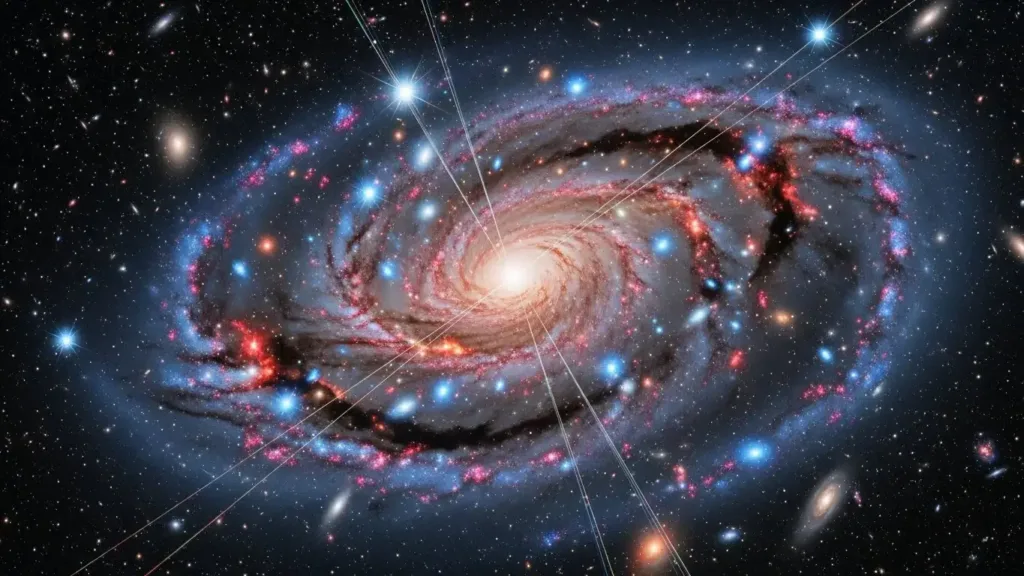
One of modern astrophysics’ most striking discoveries is the strong link between supermassive black holes and their host galaxies. Typically, black holes make up about 0.1–0.5% of a galaxy’s central bulge mass. Remarkably, this pattern holds across vast mass ranges and billions of years of cosmic history.
This link suggests that black hole growth and galaxy formation are deeply connected. If black holes grew independently, no such relationship would exist. Instead, they seem to co-evolve. Both grow together through processes like gas inflows, star formation, and feedback.
Super-Eddington accretion adds complexity. Early black holes might have grown faster than their galaxies for a while, then waited for the galaxies to catch up through later star formation. Alternatively, intense AGN feedback during these rapid growth phases might have regulated galaxy growth, keeping the overall relationship intact even as both grew quickly.
Recent observations hint that early galaxies may have different black hole–galaxy mass ratios than what we see today. Some high-redshift galaxies appear “overmassive,” with black holes making up 1% or more of the stellar mass. If confirmed with larger samples, this shift could reveal how super-Eddington accretion influenced galaxy evolution.
Black hole growth also links to chemical evolution. Massive stars formed during starbursts produce heavy elements and spread them through supernova explosions. Black hole-driven winds can further distribute—or even remove—these enriched materials. Early galaxies hosting super-Eddington black holes may have undergone unusual chemical changes, leaving clues we can still detect in today’s galaxies.
Future Observations and Predictions
The revolution in understanding rapidly growing black holes is just beginning. Future telescopes and missions promise to answer fundamental questions while undoubtedly raising new puzzles.
Upcoming Telescopes and Missions
Several next-generation observatories are set to explore early black hole growth in unprecedented detail. The Lynx X-ray Observatory, a proposed NASA mission, aims to detect and study even the most distant super-Eddington black holes. With sensitivity 100 times greater than Chandra, Lynx could uncover intermediate-mass black holes and reveal the physics of accretion like never before. Its high-resolution X-ray spectroscopy will map the speed, composition, and structure of super-Eddington outflows, putting theoretical models to a direct test.
Meanwhile, the European Space Agency’s ATHENA (Advanced Telescope for High-Energy Astrophysics) will complement Lynx by focusing on the hot and energetic universe. Its large detectors will allow population studies of early black holes, helping scientists measure how common super-Eddington accretion was across cosmic history.
Later this decade, the Nancy Grace Roman Space Telescope will launch wide-area infrared surveys to complement JWST’s deep-field observations. Roman’s expansive field of view will spot thousands of high-redshift quasars, providing the large statistical samples needed to track how many early black holes grew through super-Eddington accretion.
On the ground, Extremely Large Telescopes—including the Giant Magellan Telescope, Thirty Meter Telescope, and European Extremely Large Telescope—will perform detailed spectroscopic follow-ups. With mirrors 5–10 times larger than today’s telescopes, they will measure black hole masses, chemical compositions, and host galaxy properties for dozens of distant systems.
Together, these observatories will transform our understanding of how the first black holes grew and evolved.
Gravitational Wave Astronomy
The upcoming Laser Interferometer Space Antenna, scheduled for launch in the 2030s, will detect gravitational waves from merging supermassive black holes across cosmic history. These observations will directly measure merger rates and black hole masses, testing whether mergers contributed significantly to early black hole growth.
LISA’s sensitivity extends to intermediate-mass black holes—the crucial 1,000-100,000 solar mass range connecting stellar remnants to supermassive black holes. Detecting these objects would provide smoking-gun evidence for medium-mass or heavy seed formation channels.
Pulsar timing arrays, which recently detected the gravitational wave background, will refine their measurements over coming years. By characterizing this background’s frequency spectrum and amplitude, astronomers can constrain the cosmic merger history and potentially identify individual nearby supermassive black hole binaries.
What Discoveries Could Confirm or Refute Theories
Several key observations would definitively advance our understanding:
Finding intermediate-mass black holes in the early universe: Detecting black holes with masses between 1,000 and 100,000 solar masses at high redshift would confirm that heavy or medium-mass seeds existed, supporting direct collapse or dense cluster formation scenarios.
Measuring super-Eddington duty cycles: Determining what fraction of time early black holes spent in super-Eddington states versus quiescence would clarify whether sustained or bursty accretion dominated. This requires large statistical samples across multiple cosmic epochs.
Observing the first black holes: JWST and future observatories might detect black holes forming in real-time during the cosmic dark ages, before the first billion years. These observations would reveal whether Population III stars, direct collapse, or other mechanisms seeded the supermassive black hole population.
Detecting photon trapping signatures: Specific spectral features and polarization patterns could directly confirm photon trapping in super-Eddington accretion disks. Such observations would validate the theoretical models explaining how black holes exceed the Eddington limit.
Mapping AGN feedback in high-redshift galaxies: Detailed studies of gas kinematics, temperature, and ionization state in early galaxies hosting rapidly growing black holes would quantify feedback’s impact on galaxy evolution and star formation.
The coming decade will likely transform our understanding of rapidly growing black holes from surprising anomalies to integral components of cosmic structure formation. Each discovery raises new questions, driving a progressive refinement of theoretical models and observational strategies.
Conclusion
The discovery of rapidly growing black holes, feeding up to 40 times the Eddington limit, is one of astrophysics’ most thrilling breakthroughs. These cosmic rebels challenge everything we thought we knew about black hole growth and matter accretion.
Super-Eddington accretion helps solve a long-standing mystery: how billion-solar-mass quasars appeared less than 700 million years after the Big Bang. By trapping photons in thick accretion disks, these black holes bypass the radiation pressure that should slow their growth. Observations of LID-568, RACS J0320-35, and dozens of similar systems prove this isn’t just theory—it’s reality.
Yet many questions remain. Did most early supermassive black holes start as stellar remnants, medium-mass cluster seeds, or heavy direct-collapse seeds? How exactly do accretion and mergers combine to build black hole mass? And how do super-Eddington episodes influence galaxy evolution, star formation, and chemical enrichment? Researchers are still piecing together the answers.
These uncertainties make the coming years incredibly exciting. Next-generation telescopes will watch the first black holes form, map super-Eddington accretion in stunning detail, and possibly detect gravitational waves from the mergers that created today’s supermassive black holes. Each discovery will sharpen our understanding of these cosmic speedsters.
The rapidly growing black holes of the early universe aren’t just bending the rules of physics—they’re rewriting them. In doing so, they reveal deep truths about how gravity, radiation, and matter interact under extreme conditions. The story of these cosmic overachievers is, in many ways, the story of how our universe filled with galaxies, stars, and ultimately, us.
Recommended Resources for Curious Minds
1. Black Holes: The Key to Understanding the Universe by Brian Cox and Jeff Forshaw: This accessible book explains black hole physics from basic principles to cutting-edge research, perfect for readers wanting deeper understanding of concepts like the Eddington limit and accretion physics.
2. The Little Book of Black Holes by Steven Gubser and Frans Pretorius: A concise, mathematically precise introduction to black hole physics that bridges popular science and technical understanding, ideal for those with some physics background.
3. Astrophysics for People in a Hurry by Neil deGrasse Tyson: While broader than just black holes, this bestseller provides essential cosmic context for understanding where black holes fit in the universe’s evolution.
4. National Geographic “Black Holes” Special Issue: Beautifully illustrated magazine edition covering recent discoveries with stunning visuals and clear explanations, excellent for visual learners wanting to see what these observations actually look like.
The links above are affiliate links. If you purchase through them, we may earn a small commission at no additional cost to you. We only recommend resources we genuinely believe enhance learning about Robotics.
FAQ: Rapidly Growing Black Holes
The fastest growing black holes are typically found in the early universe, such as LID-568, which accretes at roughly 40 times the classical Eddington limit. These extreme rates challenge traditional physics models and suggest super-Eddington accretion or unusually massive black hole seeds.
Black hole growth depends on mass, environment, and accretion rate. Under classical limits, they grow slowly over millions to billions of years. However, recent observations show some black holes can gain mass extremely fast, sometimes doubling their size in just tens of millions of years.
No. Black holes eventually slow their growth as fuel runs out, radiation feedback limits accretion, or mergers stop contributing significantly. Even supermassive black holes have practical growth ceilings determined by available gas and environmental conditions.
Mechanisms like super-Eddington accretion, slim accretion disks, and photon trapping allow black holes to grow faster than classical limits. Radiation gets trapped in dense inflows, enabling matter to fall in despite intense outward pressure.
Rapid growth injects enormous energy into the host galaxy, regulating star formation and shaping galaxy evolution. This feedback helps explain correlations between black hole mass and galaxy bulge mass and why some galaxies stop forming stars early.